



Bildegalleri
(1/6)
Retro
Til salgs
225 kr
Be om at selgeren sender med Fiks ferdig! Det er trygt, raskt, og du får varen levert til adressen din. Les mer
Beskrivelse av varen
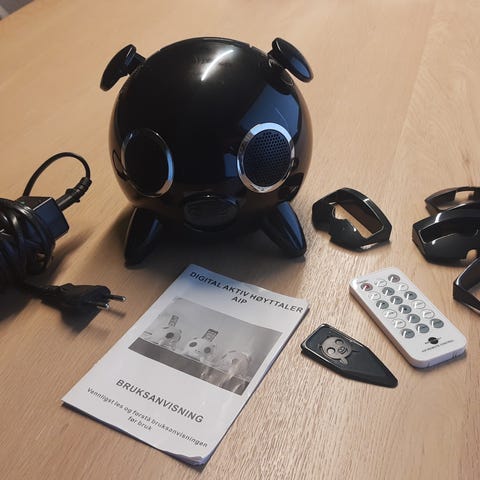
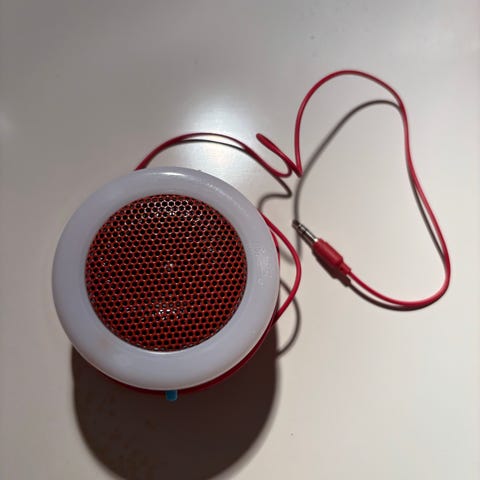
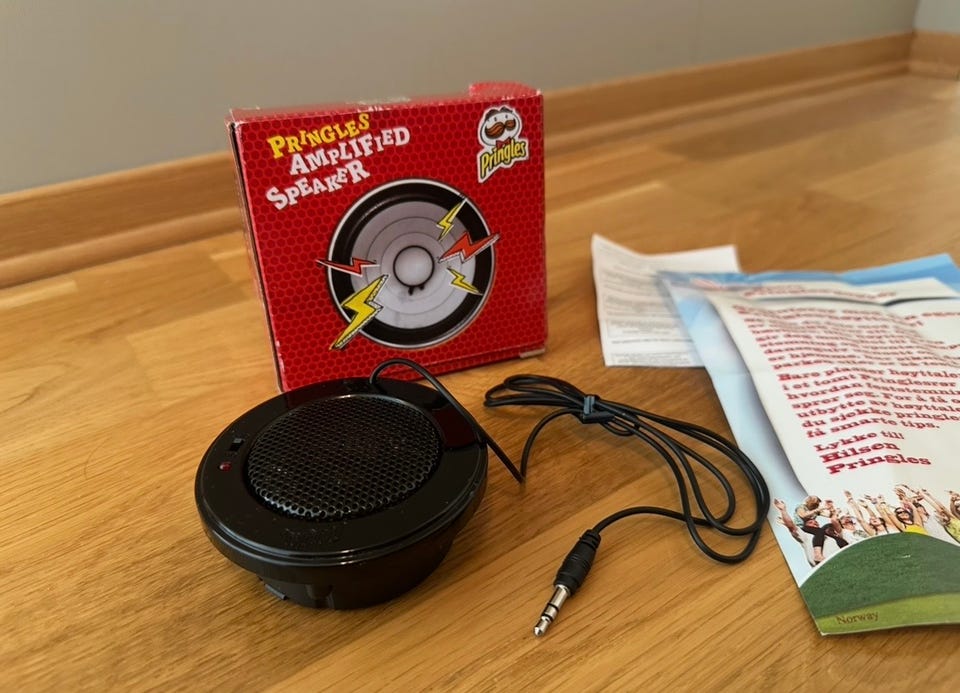
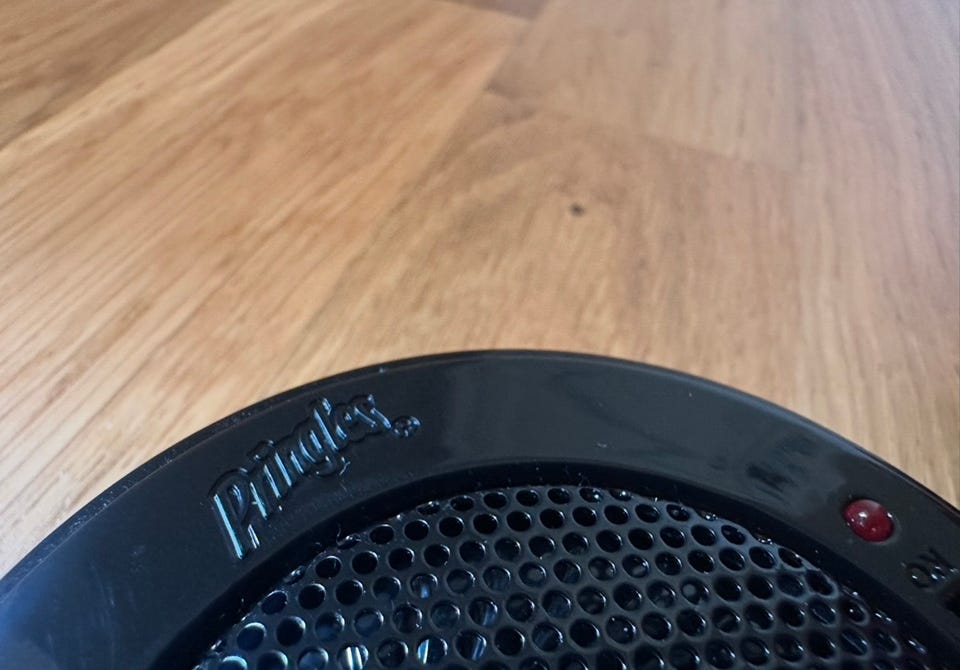
Selger en Pringles høytaler, kr 225,-
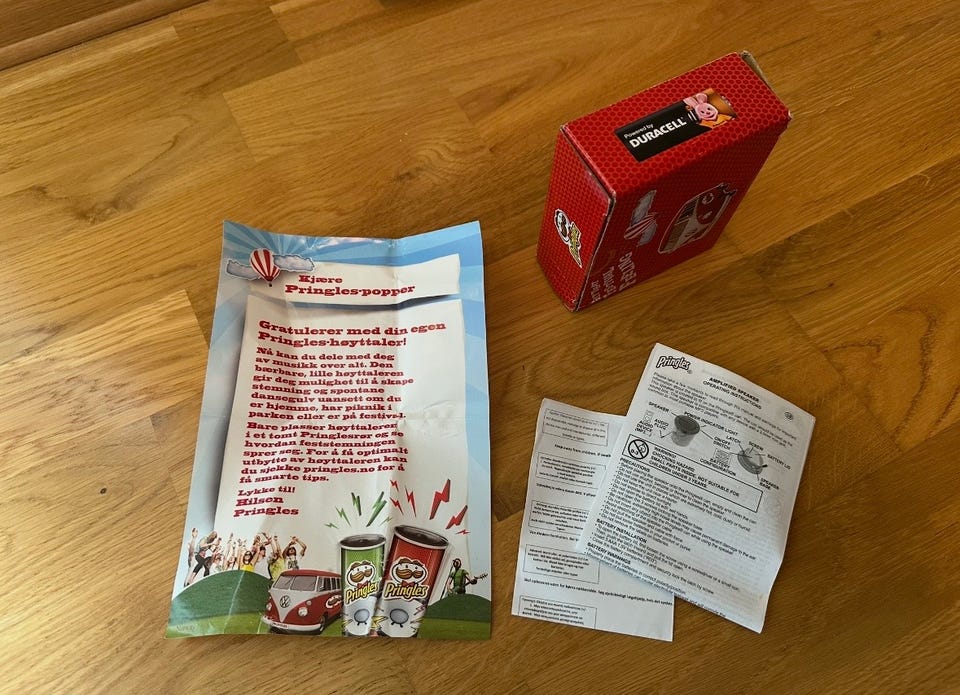
Det medfølger eske og paiprer / bruksanvisning med norsk tekst.
Kan hentes 7584 Selbustrand, eller sendes frakt med sporing kr 75,-
Har ikke teste høytaleren så vet ikke tilstanden, selges som nostalgisk verdi.
søkeord / wiki :
Dette er en høytaler merket med Pringles logo, firmaet er kjent for sine snack produkter:
Pringles er et amerikansk varemerke for ekstrudert snacks laget av tørkede poteter, vegetabilsk olje, maismel, maisstivelse, rismel, maltodekstrin, mono- og diglyserider, salt, hvetestivelse og smakstilsetninger.[1][2] Det ble produsert av det amerikanske selskapet Procter & Gamble før produksjonen ble solgt til Kellogg Company i 2012. Merket ble introdusert i 1968 og ble lansert på det norske markedet høsten 1998. Pringles er kjent for innpakningen, som består av et papprør med et plastlokk på toppen. Det er også kjent for logoen; en tegnet mann med stor bart. Potetløvene er laget i lik størrelse og i form av en sal, som gjør dem lette å stable i røret.
Pringles på øverste hylle i Sør-Korea Pringles som selges på det norske markedet er som regel produsert i Kutno i Polen. Det produseres også Pringles i Jacks. Retro høytaler, vintage, gamel, gammel, gammelt, 1990 90 tallet 2000 tallet snack snacks godt godteri potet potegull potet gull potegul, pringels pringles amplified speaker. Pringles is an American brand of stackable potato-based chips invented by Procter & Gamble (P&G) in 1968 and marketed as "Pringle's Newfangled Potato Chips". Pringles are technically considered an extruded snack because of the manufacturing process. The brand was sold in 2012 to Kellanova, which in 2024 was purchased by Mars Inc. As of 2011, Pringles were sold in more than 140 countries.[1] In 2012, Pringles were the fourth most popular snack brand after Lay's, Doritos, and Cheetos (all manufactured by Frito-Lay), with 2.2% market share globally.[2] Pringles are made from a mixture of dried potatoes, starches, flours, salts and seasonings. The dough is shaped into a saddle-shape, then fried, seasoned and placed into a cylindrical can
In 1956, Procter & Gamble assigned a task to chemist Fredric J. Baur (1918–2008): to develop a new kind of potato chip to address consumer complaints about broken, greasy, and stale chips, as well as air in the bags.[4] Baur spent two years developing saddle-shaped chips from fried dough, and selected a tubular can as the chips' container. The saddle-shape of Pringles chips is mathematically known as a hyperbolic paraboloid.[5] However, Baur could not figure out how to make the chips palatable, and was pulled off the task to work on another brand.
In the mid-1960s another P&G researcher, Alexander Liepa of Montgomery, Ohio, restarted Baur's work and succeeded in improving the taste.[6] Although Baur designed the shape of the Pringles chip, Liepa's name is on the patent.[7] Gene Wolfe, a mechanical engineer and author known for science fiction and fantasy novels, helped develop the machine that cooked them.[8][9]
In 1968, P&G first marketed Pringles in Indiana.[10][11] The earliest mention in an advertisement was on October 3, 1968,[citation needed] where a newspaper in Evansville, Indiana advertised "Pringle Potato Chips" as being "New at Kroger".[12] Afterward, they were gradually distributed around the rest of the country and by 1975, were available across most of the US. By 1991, Pringles were distributed internationally.[11]
Almost simultaneous with the Pringles test-marketing, competitor General Foods first marketed its popcorn-based snack, "Pringle's Pop Chips," in the U.S.[13][14] But because Procter & Gamble had gotten its product to retailers first, General Foods had to discontinue marketing under its chosen name.[15]
There are several theories behind the origin of the product's name. One theory refers to Mark Pringle, who filed a US Patent 2,286,644 titled "Method and Apparatus for Processing Potatoes" on March 5, 1937.[16] Pringle's work was cited by P&G in filing their own patent for improving the taste of dehydrated processed potatoes.[6] Another theory suggests that two Procter advertising employees lived on Pringle Drive in Finneytown (north of Cincinnati, Ohio), and the name paired well with "potato chips".[6][17] Another theory says that P&G chose the Pringles name from a Cincinnati telephone book.[18] Another source says that the name Pringles was "chosen out of a hat" to promote a family name appeal.[19]
The product was originally known as Pringle's Newfangled Potato Chips, but other snack manufacturers objected, saying Pringles failed to meet the definition of a potato "chip" since they were made from a potato-based dough rather than being sliced from potatoes. The US Food and Drug Administration weighed in on the matter, and in 1975 they ruled Pringles could only use the word "chip" in their product name within the phrase: "potato chips made from dried potatoes".[20] Faced with such a lengthy and unpalatable appellation, Pringles eventually renamed their product potato "crisps", instead of chips.
In July 2008, in the London High Court, P&G lawyers successfully argued that Pringles were not crisps (the term by which potato chips are known in British English), even though labelled "Potato Crisps" on the container, as the potato content was only 42% and their shape, P&G stated, "is not found in nature". This ruling, against a United Kingdom value added tax (VAT) and Duties Tribunal decision to the contrary, exempted Pringles from the then 17.5% VAT for potato crisps and potato-derived snacks.[21] In May 2009, the Court of Appeal reversed the earlier decision. A spokesman for P&G stated it had been paying the VAT proactively and owed no back taxes.[22][23]
In April 2011, P&G agreed to the US$2.35 billion sale of the brand to Diamond Foods of California, a deal which would have more than tripled the size of Diamond's snack business.[24] However, the deal fell through in February 2012 after a year-long delay due to issues over Diamond's accounts. On May 31, 2012, Kellogg's officially acquired Pringles for $2.695 billion as part of a plan to grow its international snacks business.[25] The acquisition of Pringles made Kellogg's the second-largest snack company in the world.[26] In 2024, Kellanova, Kellogg's parent company, agreed to be purchased by Mars Inc.[27] As of 2015, there were five Pringles factories worldwide: in Jackson, Tennessee; Mechelen, Belgium; Johor, Malaysia; Kutno, Poland;[28] and Fujian, China.
Brukerprofil

Du må være logget inn for å se brukerprofiler og sende meldinger.
Annonsens metadata
Sist endret: 18.11.2026 kl. 20:57 ・ FINN-kode: 475889475