Bildegalleri
(1/7)
Indiana Jones Harry Potter
Til salgs
200 kr
Be om at selgeren sender med Fiks ferdig! Det er trygt, raskt, og du får varen levert til adressen din. Les mer
Beskrivelse av varen
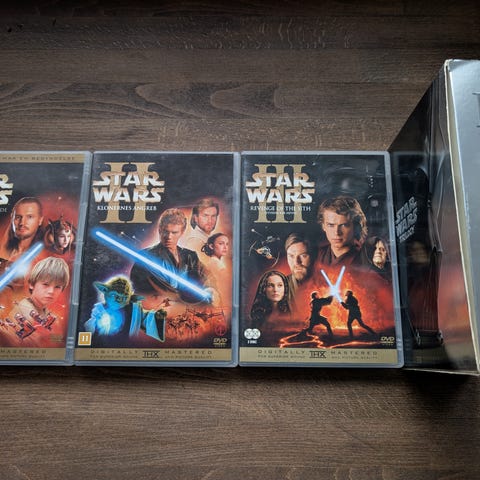
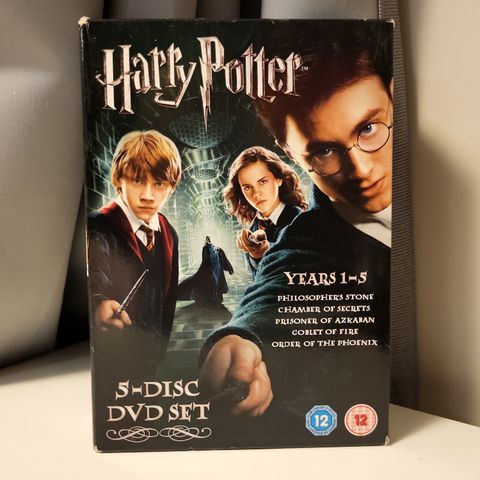
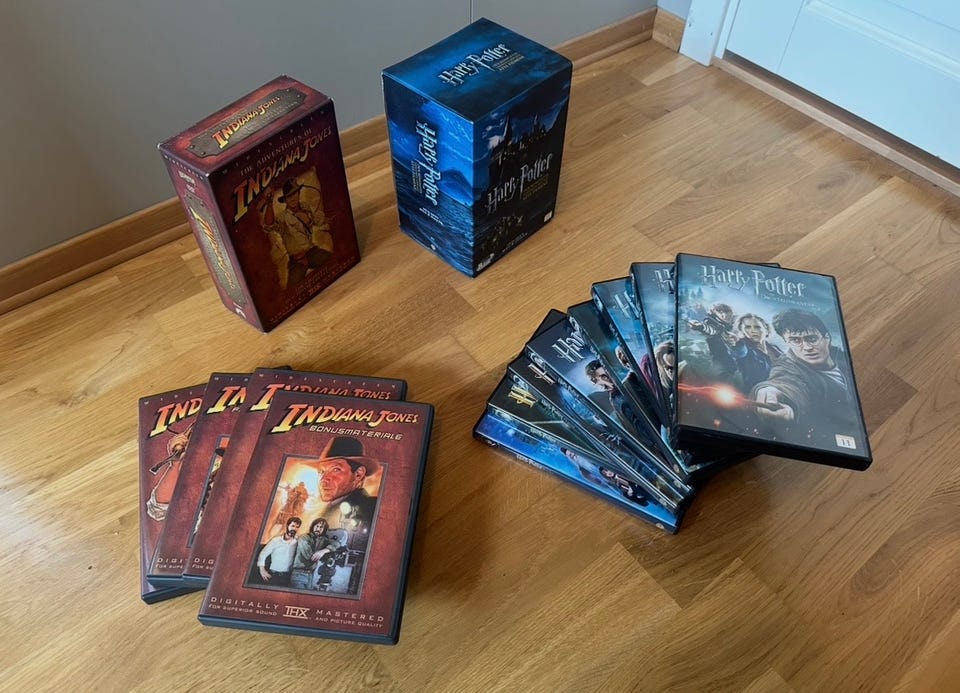
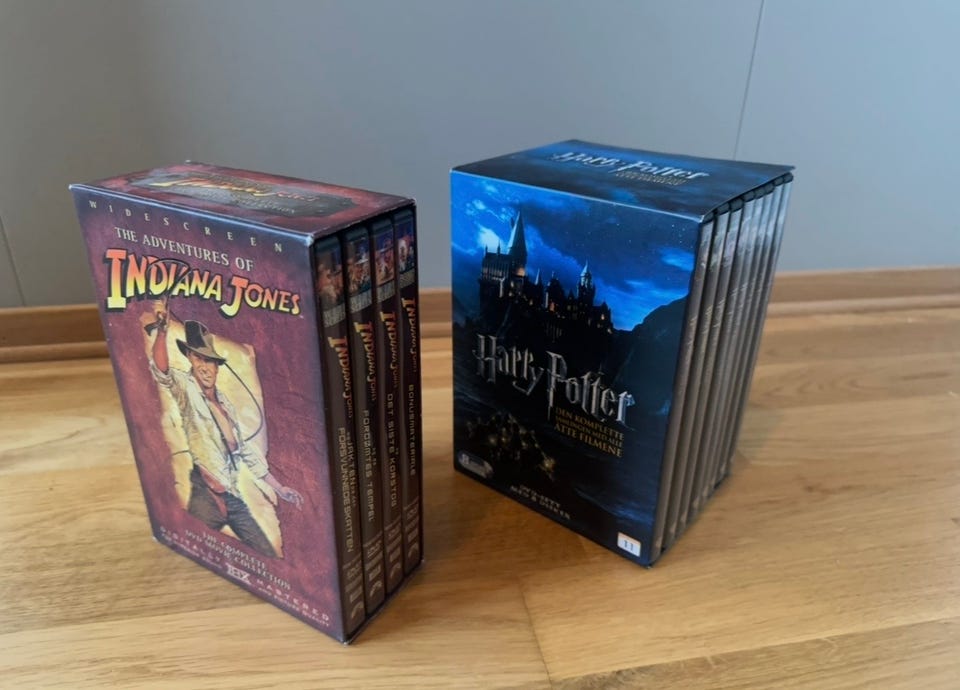
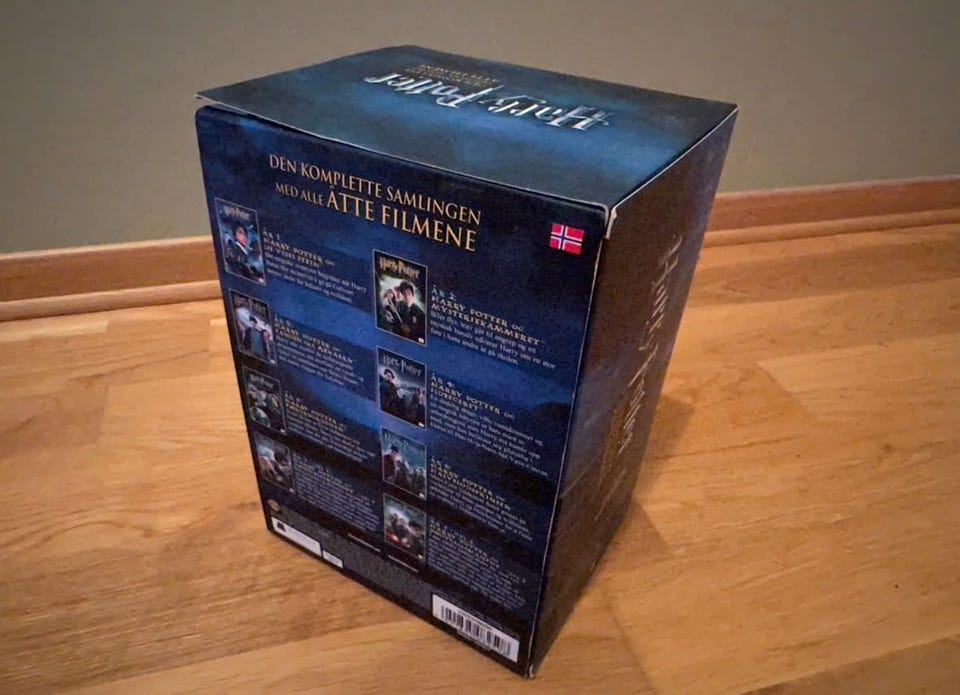
Selger 2 stykk DVD bokser samlet for kr 200,-
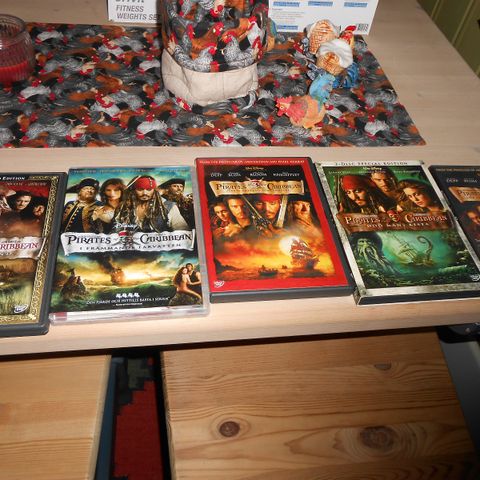
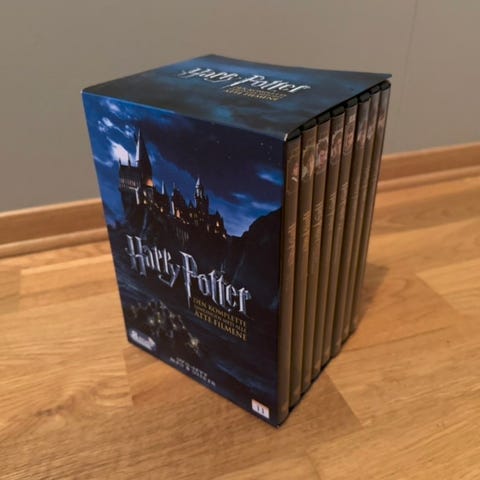
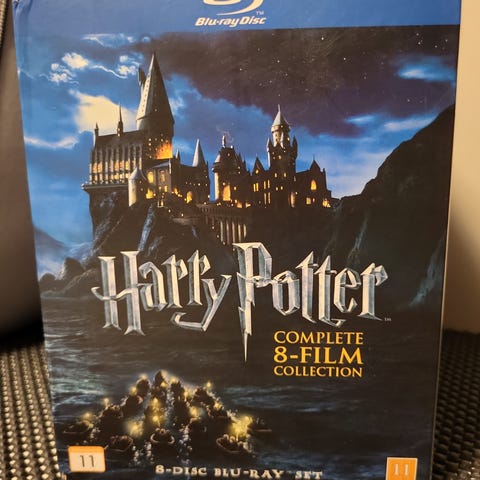
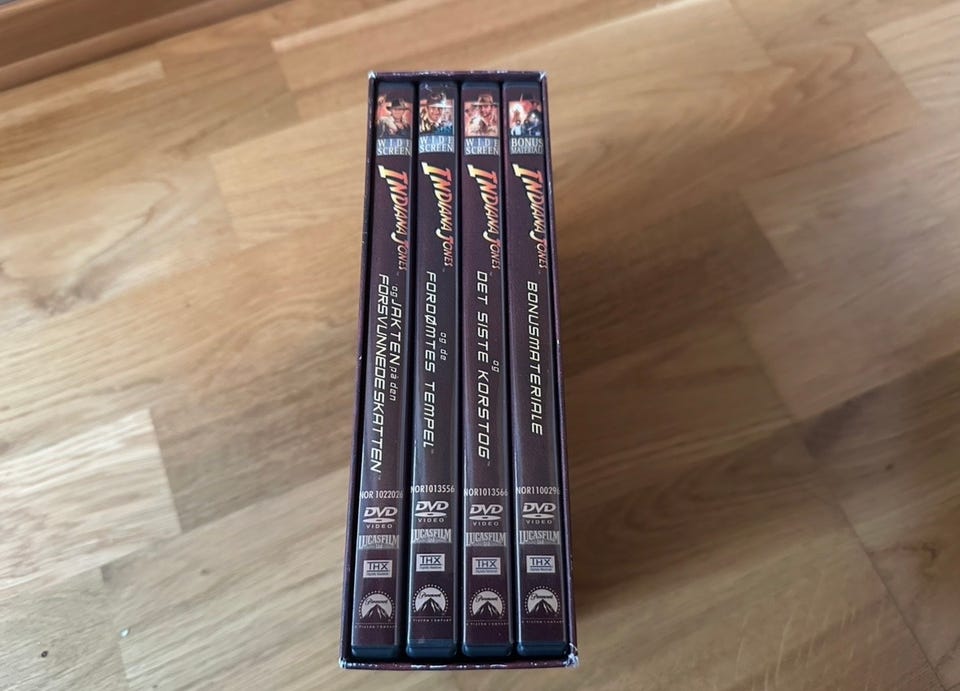
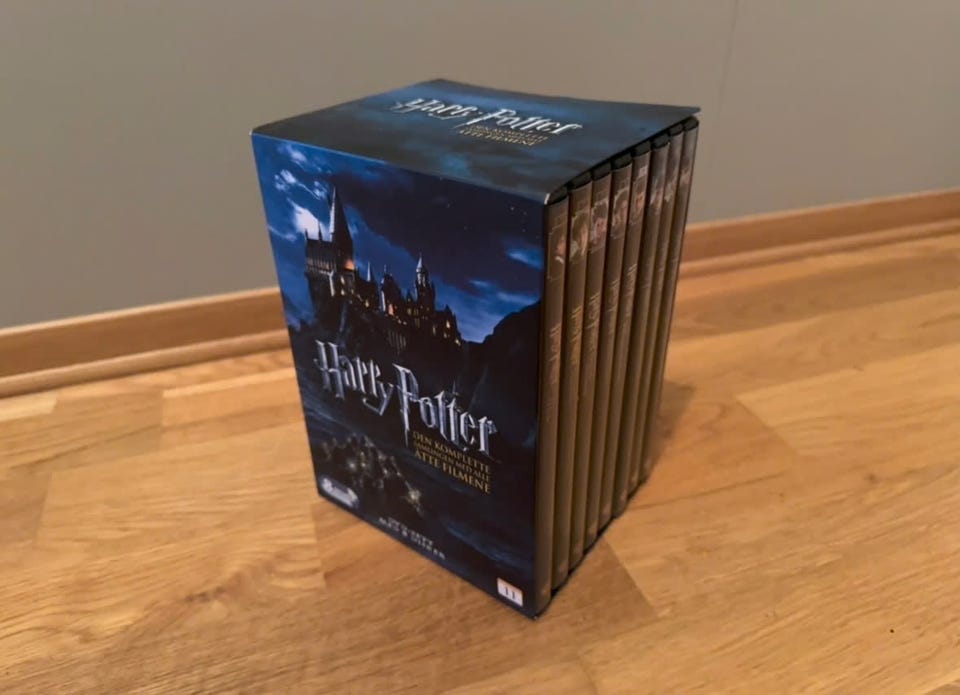
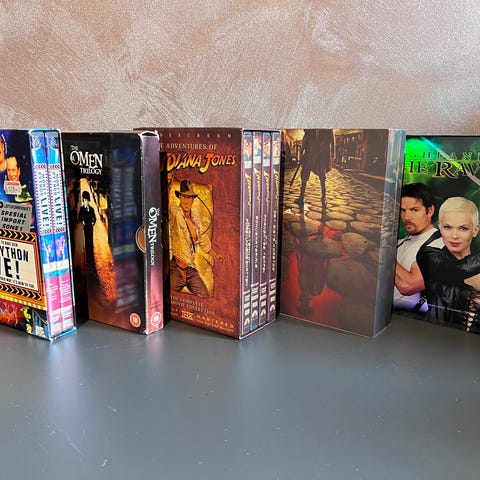
En Harry Potter DVD boks og en Idiana Jones DVD boks.
Kan hentes for kr 200,- eller sendes frakt med sporing kr 70,-
Norske utgivelser: Idiana Jones med 3 filmer og en bonus plate,
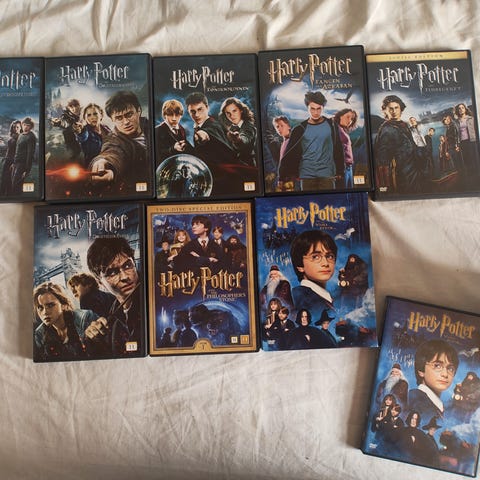
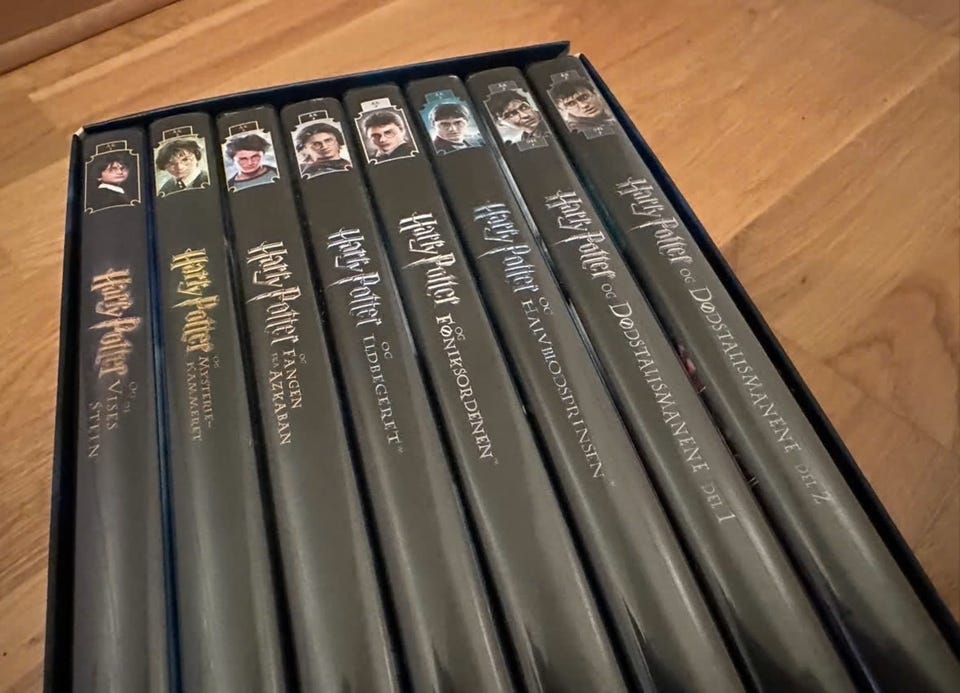
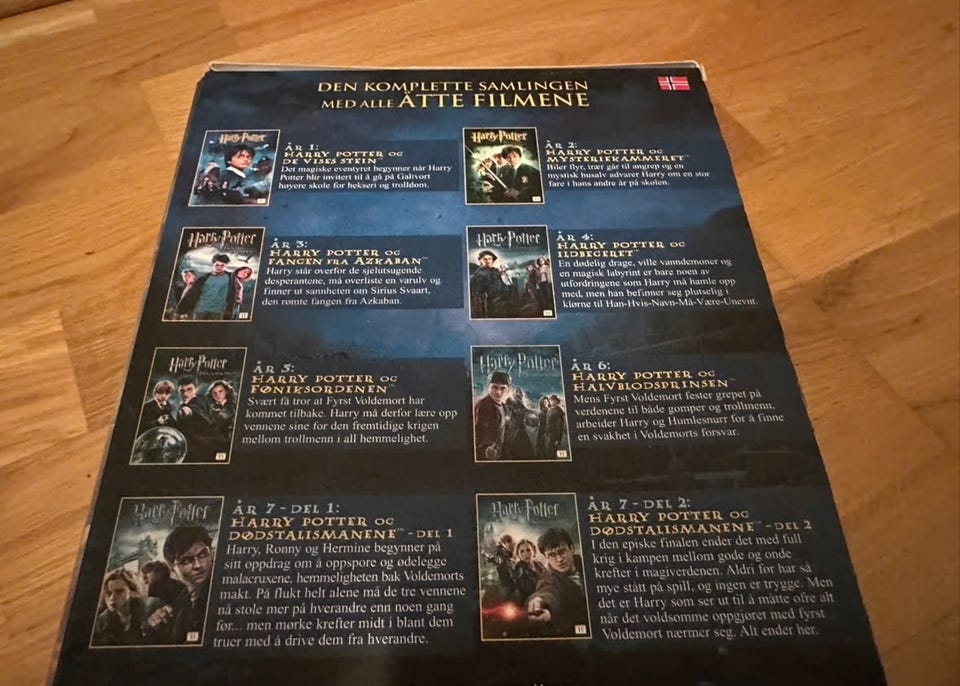
Harry Potter inneholder alle 8 filmene :
Harry Potter og de vises stein
Harry Potter og mysteriekammeret
Harry Potter og fangen fra Azkaban
Harry Potter og Ildbegeret
Harry Potter og Føniksordenen
Harry Potter og Halvblodsprinsen
Harry Potter og Dødstalismanene - Del 1
Harry Potter og Dødstalismanene – Del 2
Platene ser ut som dem er i grei tilstand med lite riper. noe mer riper
på dødstalismanene filmene.
søkeord/wikipedia: Harry Potter is a series of seven fantasy novels written by British author J. K. Rowling. The novels chronicle the lives of a young wizard, Harry Potter, and his friends, Ron Weasley and Hermione Granger, all of whom are students at Hogwarts School of Witchcraft and Wizardry. The main story arc concerns Harry's conflict with Lord Voldemort, a dark wizard who intends to become immortal, overthrow the wizard governing body known as the Ministry of Magic, and subjugate all wizards and non-magical people, known in-universe as Muggles.
The series was originally published in English by Bloomsbury in the United Kingdom and Scholastic Press in the United States. A series of many genres, including fantasy, drama, coming-of-age fiction, and the British school story (which includes elements of mystery, thriller, adventure, horror, and romance), the world of Harry Potter explores numerous themes and includes many cultural meanings and references.[1] Major themes in the series include prejudice, corruption, madness, love, and death.[2]
Since the release of the first novel, Harry Potter and the Philosopher's Stone, on 26 June 1997, the books have found immense popularity and commercial success worldwide. They have attracted a wide adult audience as well as younger readers and are widely considered cornerstones of modern literature,[3][4] though the books have received mixed reviews from critics and literary scholars. As of February 2023, the books have sold more than 600 million copies worldwide, making them the best-selling book series in history, available in dozens of languages. The last four books all set records as the fastest-selling books in history, with the final instalment selling roughly 2.7 million copies in the United Kingdom and 8.3 million copies in the United States within twenty-four hours of its release. It holds the Guinness World Record for "Best-selling book series for children."[5]
Warner Bros. Pictures adapted the original seven books into an eight-part namesake film series. In 2016, the total value of the Harry Potter franchise was estimated at $25 billion,[6] making it one of the highest-grossing media franchises of all time. Harry Potter and the Cursed Child is a play based on a story co-written by Rowling. A television series based on the books is in production at HBO.
The success of the books and films has allowed the Harry Potter franchise to expand with numerous derivative works, a travelling exhibition that premiered in Chicago in 2009, a studio tour in London that opened in 2012, a digital platform on which J. K. Rowling updates the series with new information and insight, and a trilogy of spin-off films premiering in November 2016 with Fantastic Beasts and Where to Find Them, among many other developments. Themed attractions, collectively known as The Wizarding World of Harry Potter, have been built at several Universal Destinations & Experiences amusement parks around the world.
The series follows the life of a boy named Harry Potter. In the first book, Harry Potter and the Philosopher's Stone (Harry Potter and the Sorcerer's Stone in the US), Harry lives in a cupboard under the stairs in the house of the Dursleys, his aunt, uncle and cousin, who all treat him poorly. At the age of 11, Harry discovers that he is a wizard. He meets a half-giant named Hagrid who gives him a letter of acceptance to attend the Hogwarts School of Witchcraft and Wizardry. Harry learns that his parents, Lily and James Potter, also had magical powers and were murdered by the dark wizard Lord Voldemort when Harry was a baby. When Voldemort attempted to kill Harry, his curse rebounded, seemingly killing Voldemort, and Harry survived with a lightning-shaped scar on his forehead. The event made Harry famous among the community of wizards and witches.
Harry becomes a student at Hogwarts and is sorted into Gryffindor House. He gains the friendship of Ron Weasley, a member of a large but poor wizarding family, and Hermione Granger, a witch of non-magical, or Muggle, parentage. The trio develop an enmity with the rich pure-blood student Draco Malfoy. Harry encounters the school's headmaster, Albus Dumbledore; the potions professor, Severus Snape, who displays a dislike for him; and the Defence Against the Dark Arts teacher, Quirinus Quirrell. Quirrell turns out to be allied with Voldemort, who is still alive as a weak spirit. The first book concludes with Harry's confrontation with Voldemort, who, in his quest to regain a body, yearns to possess the Philosopher's Stone, a substance that bestows everlasting life.
Harry Potter and the Chamber of Secrets describes Harry's second year at Hogwarts. Students are attacked and petrified by an unknown creature; wizards of Muggle parentage are the primary targets. The attacks appear related to the mythical Chamber of Secrets and resemble attacks fifty years earlier. Harry discovers an ability to speak the snake language Parseltongue, which he learns is rare and associated with the Dark Arts. When Hermione is attacked and Ron's younger sister Ginny Weasley is abducted, Harry and Ron uncover the chamber's secrets and enter it. Harry discovers that Ginny was possessed by an old diary, inside which the memory of Tom Marvolo Riddle, Voldemort's younger self, resides. On Voldemort's behalf, Ginny opened the chamber and unleashed the basilisk, an ancient monster that kills or petrifies those who make direct or indirect eye contact, respectively. With the help of Dumbledore's phoenix, Fawkes, and the Sword of Gryffindor, Harry slays the basilisk and destroys the diary.
In the third novel, Harry Potter and the Prisoner of Azkaban, Harry learns that he is targeted by Sirius Black, an escaped convict who allegedly assisted in his parents' murder. Dementors, creatures that feed on happiness, search for Sirius and guard the school. As Harry struggles with his reaction to the dementors, he reaches out to Remus Lupin, a new professor who teaches him the Patronus charm. On a windy night, Ron is dragged by a black dog into the Shrieking Shack, a haunted house, and Harry and Hermione follow. The dog is revealed to be Sirius Black. Lupin enters the shack and explains that Sirius was James Potter's best friend; he was framed by another friend of James, Peter Pettigrew, who hides as Ron's pet rat, Scabbers. As the full moon rises, Lupin transforms into a werewolf and bounds away, and the group chase after him. They are surrounded by dementors, but are saved by a figure resembling James who casts a stag Patronus. This is later revealed to be a future version of Harry, who travelled back in time with Hermione using a device called a Time Turner. The duo help Sirius escape on a Hippogriff, while Pettigrew escapes. Harry's fourth year of school (detailed in Harry Potter and the Goblet of Fire), Hogwarts hosts the Triwizard Tournament, a contest between Hogwarts and the schools Beauxbatons and Durmstrang. Harry is unwillingly entered into the contest, becoming Hogwarts' second participant after Cedric Diggory, an unusual occurrence that causes his friends to distance themselves from him. Harry claims the Triwizard Cup with Cedric, but he is teleported to a graveyard where Pettigrew kills Cedric, then resurrects Voldemort using Harry's blood. Voldemort convenes his supporters, the Death Eaters, and Harry manages to escape after a duel with Voldemort. Upon returning to Hogwarts, it is revealed that a Death Eater, Barty Crouch, Jr, in disguise as the new Defence Against the Dark Arts professor, Alastor "Mad-Eye" Moody, engineered Harry's entry into the tournament, secretly helped him, and had him teleported to Voldemort.
In the fifth book, Harry Potter and the Order of the Phoenix, the Ministry of Magic refuses to believe that Voldemort has returned. Dumbledore re-activates the Order of the Phoenix, a secret society to counter Voldemort; meanwhile, the Ministry tightens control of Hogwarts by appointing Dolores Umbridge as High Inquisitor of Hogwarts, and she gradually increases her powers. When Umbridge bans practical teaching of Defence Against the Dark Arts, Harry, Ron and Hermione form "Dumbledore's Army", a secret group to continue the teachings. Harry has recurring dreams of a dark corridor in the Ministry of Magic, eventually dreaming that Sirius is being tortured there. He races to the Ministry with his friends, but it is a trap, planted in his head by Voldemort. The group are attacked by Death Eaters and saved by the Order of the Phoenix, but Sirius is killed in the battle. A duel between Dumbledore and Voldemort convinces the ministry of Voldemort's return. A prophecy concerning Harry and Voldemort is revealed: one must die at the hands of the other.
In the sixth book, Harry Potter and the Half-Blood Prince, Snape teaches Defence Against the Dark Arts while Horace Slughorn becomes the Potions master. Harry finds an old textbook with annotations by the Half-Blood Prince, due to which he achieves success in Potions class. Harry also takes private sessions with Dumbledore, viewing memories about the early life of Voldemort in a device called a Pensieve. Harry learns from a drunken Slughorn that he used to teach Tom Riddle, and that Voldemort divided his soul into pieces, creating a series of Horcruxes. Harry and Dumbledore travel to a distant lake to destroy a Horcrux; they succeed, but Dumbledore weakens. On their return, they find Draco Malfoy and Death Eaters attacking the school. The book ends with the killing of Dumbledore by Professor Snape, the titular Half-Blood Prince.
In Harry Potter and the Deathly Hallows, the seventh and final novel in the series, Lord Voldemort gains control of the Ministry of Magic. Harry, Ron and Hermione learn about the Deathly Hallows, legendary items that lead to mastery over death. The group infiltrates the ministry, where they steal a locket Horcrux, and visit Godric's Hollow, where they are attacked by Nagini, Voldemort's snake. A silver doe Patronus leads them to the Sword of Gryffindor, with which they destroy the locket. They steal a Horcrux from Gringotts and travel to Hogwarts, culminating in a battle with the Death Eaters. Snape is killed by Voldemort out of paranoia, but he lends Harry his memories before he dies. Harry learns that Snape was always loyal to Dumbledore, and that Harry is himself a Horcrux. Harry surrenders to Voldemort and is hit with the killing curse; however he is not killed as the protection Lily gave him lives on within Voldemort since he used Harry's blood to resurrect himself. The defenders of Hogwarts continue to fight on; Harry comes back from limbo, faces Voldemort and kills him.
An epilogue titled "Nineteen Years Later" describes the lives of the surviving characters and the impact of Voldemort's death. Harry and Ginny are married with three children, and Ron and Hermione are married with two children.
Style and allusions
Genre and style
The novels fall into the genre of fantasy literature, and qualify as a type of fantasy called "urban fantasy", "contemporary fantasy", or "low fantasy". They are mainly dramas, and maintain a fairly serious and dark tone throughout, though they do contain some notable instances of tragicomedy and black humour. In many respects, they are also examples of the bildungsroman, or coming of age novel,[7] and contain elements of mystery, adventure, horror, thriller, and romance. The books are also, in the words of Stephen King, "shrewd mystery tales",[8] and each book is constructed in the manner of a Sherlock Holmes-style mystery adventure. The stories are told from a third person limited point of view with very few exceptions (such as the opening chapters of Philosopher's Stone, Goblet of Fire and Deathly Hallows and the first two chapters of Half-Blood Prince).
The series can be considered part of the British children's boarding school genre, which includes Rudyard Kipling's Stalky & Co., Enid Blyton's Malory Towers, St. Clare's and the Naughtiest Girl series, and Frank Richards's Billy Bunter novels: the Harry Potter books are predominantly set in Hogwarts, a fictional British boarding school for wizards, where the curriculum includes the use of magic.[9] In this sense they are "in a direct line of descent from Thomas Hughes's Tom Brown's School Days and other Victorian and Edwardian novels of British public school life", though they are, as many note, more contemporary, grittier, darker, and more mature than the typical boarding school novel, addressing serious themes of death, love, loss, prejudice, coming-of-age, and the loss of innocence in a 1990s British setting.[10][11][failed verification]
In Harry Potter, Rowling juxtaposes the extraordinary against the ordinary.[12] Her narrative features two worlds: a contemporary world inhabited by non-magical people called Muggles, and another featuring wizards. It differs from typical portal fantasy in that its magical elements stay grounded in the mundane.[13] Paintings move and talk; books bite readers; letters shout messages; and maps show live journeys, making the wizarding world both exotic and familiar.[12][14] This blend of realistic and romantic elements extends to Rowling's characters. Their names are often onomatopoeic[clarification needed]: Malfoy is difficult, Filch is unpleasant, and Lupin is a werewolf.[15][16] Harry is ordinary and relatable, with down-to-earth features such as wearing broken glasses;[17] the scholar Roni Natov terms him an "everychild".[18] These elements serve to highlight Harry when he is heroic, making him both an everyman and a fairytale hero.[17][19]
Each of the seven books is set over the course of one school year. Harry struggles with the problems he encounters, and dealing with them often involves the need to violate some school rules. If students are caught breaking rules, they are often disciplined by Hogwarts professors. The stories reach their climax in the summer term, near or just after final exams, when events escalate far beyond in-school squabbles and struggles, and Harry must confront either Voldemort or one of his followers, the Death Eaters, with the stakes a matter of life and death—a point underlined, as the series progresses, by characters being killed in each of the final four books.[20][21] In the aftermath, he learns important lessons through exposition and discussions with head teacher and mentor Albus Dumbledore. The only exception to this school-centred setting is the final novel, Harry Potter and the Deathly Hallows, in which Harry and his friends spend most of their time away from Hogwarts, and only return there to face Voldemort at the dénouement.[20]
Allusions
The Harry Potter stories feature imagery and motifs drawn from Arthurian myth and fairytales. Harry's ability to draw the Sword of Gryffindor from the Sorting Hat resembles the Arthurian sword in the stone legend.[22] His life with the Dursleys has been compared to Cinderella.[23] Hogwarts resembles a medieval university-cum-castle with several professors who belong to an Order of Merlin; Old Professor Binns still lectures about the International Warlock Convention of 1289; and a real historical person, a 14th-century scribe, Sir Nicolas Flamel, is described as a holder of the Philosopher's Stone.[24] Other medieval elements in Hogwarts include coats-of-arms and medieval weapons on the walls, letters written on parchment and sealed with wax, the Great Hall of Hogwarts, which is similar to the Great Hall of Camelot, the use of Latin phrases, the tents put up for Quidditch tournaments, which are similar to the "marvellous tents" put up for knightly tournaments, imaginary animals like dragons and unicorns that exist around Hogwarts, and the banners with heraldic animals for the four Houses of Hogwarts.[24]
Many of the motifs of the Potter stories, such as the hero's quest invoking objects that confer invisibility, magical animals and trees, a forest full of danger and the recognition of a character based upon scars, are drawn from medieval French Arthurian romances.[24] Other aspects borrowed from French Arthurian romances include the use of owls as messengers, werewolves as characters, and white deer.[24] The American scholars Heather Arden and Kathryn Lorenz in particular argue that many aspects of the Potter stories are inspired by a 14th-century French Arthurian romance, Claris et Laris, writing of the "startling" similarities between the adventures of Potter and the knight Claris.[24] Arden and Lorenz noted that Rowling graduated from the University of Exeter in 1986 with a degree in French literature and spent a year living in France afterwards.[24]
Like C. S. Lewis's The Chronicles of Narnia, Harry Potter also contains Christian symbolism and allegory. The series has been viewed as a Christian moral fable in the psychomachia tradition, in which stand-ins for good and evil fight for supremacy over a person's soul.[25] Children's literature critic Joy Farmer sees parallels between Harry and Jesus Christ.[26] Comparing Rowling with Lewis, she argues that "magic is both authors' way of talking about spiritual reality".[27] According to Maria Nikolajeva, Christian imagery is particularly strong in the final scenes of the series: Harry dies in self-sacrifice and Voldemort delivers an "ecce homo" speech, after which Harry is resurrected and defeats his enemy.[28]
Rowling stated that she did not reveal Harry Potter's religious parallels in the beginning because doing so would have "give[n] too much away to fans who might then see the parallels".[29] In the final book of the series, Harry Potter and the Deathly Hallows, Rowling makes the book's Christian imagery more explicit, quoting both Matthew 6:21 and 1 Corinthians 15:26 (King James Version) when Harry visits his parents' graves.[29] Hermione Granger teaches Harry Potter that the meaning of these verses from the Christian Bible are "living beyond death. Living after death", which Rowling states "epitomize the whole series".[29][30][31] Rowling also exhibits Christian values in developing Albus Dumbledore as a God-like character, the divine, trusted leader of the series, guiding the long-suffering hero along his quest. In the seventh novel, Harry speaks with and questions the deceased Dumbledore much like a person of faith would talk to and question God.[32][full citation needed]
Harry Potter er en serie på sju fantasy-romaner skrevet for barn og ungdom av den britiske forfatteren J.K. Rowling. Bøkene ble kåret til de beste ungdomsbøkene gjennom tidene av National Public Radios lyttere i 2012.[1] Den første boken i Harry Potter-serien ble utgitt 1997. Serien har, med et samlet salg på over 690 millioner bøker på i alt 80 språk, oppnådd en utbredelse, kommersiell suksess og kulturell status ingen annen bokserie er i nærheten av. På engelsk blir Harry Potter-bøkene utgitt av forlagene Bloomsbury (Storbritannia), Scholastic Press (USA), Allen & Unwin (Australia) og Raincoast Books (Canada). I Norge har de blitt oversatt av Torstein Bugge Høverstad og utgitt av Cappelen Damm.
Bøkene handler om den foreldreløse trollmannsgutten Harry Potter og hans kamp mot den onde trollmannen Voldemort som drepte foreldrene hans da han var spedbarn. Harry Potter fikk sitt velkjente lynarr som følge av hendelsen. Bokserien følger Harry Potter fra han er elleve år gammel. Hver bok omhandler et nytt skoleår ved Galtvort høyere skole for hekseri og trolldom, og Potters kamp mot Voldemort og hans følgere som er kaldt dødsetere. Rowlings univers er fullt av magiske vesner som eksisterer skjult for vanlige mennesker, også kalt gomper. Bøkene er lange og handlingsmettede og inneholder humor, spenning og tildels voldsom dramatikk. Bokserien er lovprist for å oppmuntre barn til å lese, men den har også fått kritikk fra enkelte kristne miljøer på grunn av tilstedeværelsen av magi og onde, ikke-kristne krefter.[trenger referanse]
Utgivelsene av bøkene har fulgt en godt regissert og annonsert fremdriftsplan. Den siste boka i serien, Harry Potter og dødstalismanene, ble lansert på engelsk den 21. juli 2007, og på norsk den 1. desember 2007. Den første romanen, Harry Potter og de vises stein, ble lansert i 1997 i engelsk versjon og i 1999 i norsk versjon, og den nest siste boken, Harry Potter og Halvblodsprinsen, ble lansert i 2005. Alle bøkene er filmatisert. Det ble bestemt at Harry Potter og Dødstalismanene skulle deles i to deler, og den første filmen hadde premiere 12. november 2010, mens den andre og siste delen hadde premiere 15. juli 2011.
Bøkene
Bokserien
Harry Potter og de vises stein (Harry Potter and the Philosopher's Stone i Storbritannia og Harry Potter and the Sorcerer's Stone i USA)
Tiden historien er lagt til: 1981, 1991 til 1992
Lansering: 26. juni 1997 (UK); 1. september 1998 (U.S.); 1999 (Norge)
salg i USA: 17 millioner.
Harry Potter og Mysteriekammeret (Harry Potter and the Chamber of Secrets i Storbritannia)
Tiden historien er lagt til: 1943, 1992 til 1993
Lansering: 2. juli 1998 (UK); 2. juni 1999 (U.S.); vår 2000 (Norge)
salg i USA: 14.7 millioner.
Harry Potter og fangen fra Azkaban (Harry Potter and the Prisoner of Azkaban i Storbritannia)
Tiden historien er lagt til: 1993 til 1994
Lansering: 8. juli 1999 (UK); 8. september 1999 (U.S.); høst 2000 (Norge)
salg i USA: 12.8 millioner.
Harry Potter og ildbegeret (Harry Potter and the Goblet of Fire i Storbritannia)
Tiden historien er lagt til: 1944, 1994 til 1995
Lansering: 8. juli, 2000 (UK/U.S.); 2001 (Norge)
salg i USA: 12.3 millioner.
Harry Potter og Føniksordenen (Harry Potter and the Order of the Phoenix i Storbritannia)
Tiden historien er lagt til: 1976, 1995 til 1996
Lansering: 2003 (over hele verden)
salg i USA: 15.9 millioner.
Harry Potter og Halvblodsprinsen (Harry Potter and the Half-Blood Prince i Storbritannia)
Tiden historien er lagt til:1926, 1960, 1970, 1996 til 1997
Lansering: 2005 (over hele verden)
salg i USA: 11 millioner.
Harry Potter og dødstalismanene (Harry Potter and the Deathly Hallows i Storbritannia)
Tiden historien er lagt til: 1997 til 1998, (2017)
Lansering: 2007 (over hele verden)
Salg i USA: Amazon.com annonserte allerede i mai 2007 at de hadde forhåndssolgt over 1 million bøker[2]
Harry Potter og barnets forbannelse (Harry Potter and the Cursed Child i Storbritannia) (manusbok)
Tiden historien er lagt til: 2017
Lansering: 2016
Bøkene har blitt populære nok til at bokhandlere over hele verden holdt samtidige «lanseringsfester» på dagene da de siste Harry Potter-bøkene ble lanserte, siden det tidligste bøkene kan bli solgt enkeltvis er ett minutt over midnatt GMT. Harry Potter-bøkene er oversatt til over 60 språk. På engelsk eksisterer det en tilpasset amerikansk versjon av samtlige bøker. De norske versjonene blir oversatt av Torstein Bugge Høverstad. Det er også laget lydbøker av bokserien. I Norge er det Torstein Bugge Høverstad for Fono Forlag som leser i alle lydbøkene.
Handlingsforløp i bøkene
Hovedpersonen i bøkene er Harry Potter, som lever sammen med sin onkel, tante og fetter - familien Dumling. Når han er elleve år gammel finner Harry ut at han er en trollmann, selv om han lever i en verden med mennesker helt uten magiske evner kalt gomper. Harry begynner på Galtvort høyere skole for hekseri og trolldom, et trollmannsakademi i Skottland, og det er her mesteparten av handlingene i bokserien tar plass.
Da Harry bare var et barn ble begge foreldrene hans drept av den mektige trollmannen Voldemort. Voldemort prøvde også å drepe Harry, men klarte ikke dette. På grunn av foreldrenes død ble Harry boende hos tanten og onkelen. På Galtvort ble han kjent med Ronny Wiltersen og Hermine Grang som ble Harrys beste venner, og sammen havnet de i mye trøbbel i løpet av de syv årene på skolen.
I den første, andre, tredje og femte boka starter i eller ved huset til familien Dumling. I den fjerde, sjette og sjuende boka er handlingen lagt til et annet sted i første kapittel, men også i disse bøkene starter handlingen der Harry er involvert hos Dumlingene. Alle bøkene (unntatt den første, der Harry fortsatt er liten) starter i sommerferien mens Harry venter på å returnere til Galtvort. Bøkene blir skrevet i tredje person, med Harry som sentral figur. Hver bok representerer et år i Harrys liv i perioden mellom 1991 og 1998.[trenger referanse]
Hver bok beskriver mer eller mindre det som skjer i løpet av et år av Harrys liv, fra sommerferien hjemme hos familien Dumling, der han ikke er spesielt godt likt, til hans skoleår ved Galtvort høyere skole for hekseri og trolldom, der han lærer å bruke magi, og frem til neste sommer begynner. I de fem første bøkene slutter handlingen enten på Galtvortekspressen eller like etter at han har gått av toget på vei hjem til Dumlingenes hjem i Søndre Syting, sør for London. Hver bok avsluttes med et høydepunkt bygget opp av handlingen i samme bok. I alle bøkene, bortsett fra i Harry Potter og fangen fra Azkaban, er dette høydepunktet Harrys møte med Voldemort. I akkurat denne boken er ikke Voldemort med i det hele tatt. Isteden møter Harry sin gudfar Sirius, som man antok jobbet for Voldemort.
Hver av de sju bøkene i serien er mørkere enn sin forgjenger, og gjennspeiler at Harry blir eldre og hans erkefiende fyrst Voldemort blir sterkere. I de tidligste bøkene lærer Harry akkurat nok på Galtvort til å kunne kjempe mot Voldemort i slutten av boken.
Bakgrunn
Ifølge forfatter J.K. Rowling kom hun på historiene om Harry Potter på en togtur fra Manchester til London i 1991. Hennes favorittsted for å skrive bøker var en kafé i Edinburgh, mens hun drakk uendelig mange kaffekopper. Salget fra bøkene, samt honorar fra filmene og spinoffproduktene, har gjort at Rowling er den 620. rikeste personen i verden[3], noe som gjør henne rikere enn dronning Elizabeth.
Bøkene har tilhengere i alle aldre, og J.K. Rowling har sagt at hun ikke hadde noen spesiell aldersgruppe i tankene da hun begynte å skrive dem. Utgiverne av bøkene har imidlertid rettet bøkene mot unge lesere, mellom 9 og 15 år. Bøkene har senere blitt lansert i to versjoner, en med det originale «barneomslaget» og en med et omslag som er mer rettet mot voksne lesere. I tillegg, etter som serien har utviklet seg, har Rowlings skrivestil blitt mer sofistikert, og innholdet i bøkene har modnet sammen med hovedpersonen. For eksempel blir romantiske forhold en viktig del av de senere bøkene.
Rowling lar ideer om rasisme, folkemord og fordommer komme med i boken; disse er Voldemorts og hans dødseteres varemerke, men også av og til vist i forholdet mellom magikere, ikke magiske folk (gomper, engelsk muggles) og magiske vesener i den magiske verdenen, slik som varulver og vampyrer. Dessuten omspiller noe av handlingen kjærlighet, både oppofrende kjærlighet (først da Harrys mor Lilly ofrer livet sitt for ham, og senere når Harry godtar å selv dø for å kunne drepe Voldemort) og romantisk kjærlighet (spesielt i de siste bøkene). Ifølge Humlesnurr var kjærlighet grunnen til at Harry overlevde da Voldemort prøvde å drepe ham, og også mye av grunnen til at Voldemort flere ganger i løpet av bøkene mislykkes i å drepe ham.
Sammenligninger
Bøkene er sammenlignet med mange velkjente verk, som C.S. Lewis' Narnia og J.R.R. Tolkiens Ringenes herre. De passer også inn i en britisk sjanger om kostskolelivet, og seksjoner som inneholder familien Dumling minner veldig om Roald Dahls bøker, i tillegg til at Harrys situasjon i den første boken (Harry Potter og de vises stein) med sistnevnte, også kan minne om Askepotts. Charles Dickens og Douglas Adams blir pekt ut som mulige kilder av andre lesere.
Temaer i bøkene
Ifølge Rowling selv er et stort tema død: "My books are largely about death. They open with the death of Harry's parents. There is Voldemort's obsession with conquering death and his quest for immortality at any price, the goal of anyone with magic. I so understand why Voldemort wants to conquer death. We're all frightened of it."[4]
Bøkene har også mange andre temaer som makt/maktmisbruk, vold, kjærlighet, tap, håp, fordommer og mer, men Rowling ville ikke sitte og skrive, og bevisst prøve å få dette fram til leseren, men heller la det vokse litt av seg selv.
Skolebøkene
I 2001 utga Rowling to Harry Potter-bøker utenom den ordinære serien. Bøkene er skrevet under psevdonym og gir seg ut for å være opptrykk av faktiske bøker fra Harry Potter-universet (som forklart i et forord av rektor Humlesnurr), den ene en av Harrys egne skolebøker (med notater av Harry og hans venner), den andre en bok fra Galtvort skolebibliotek. Overskuddet fra begge bøker går til inntekt for Comic Relief.
Fabeldyr og hvor de er å finne (Fantastic Beasts and Where to Find Them) av Salmander Fisle
Rumpeldunk gjennom tidene (Quidditch Through the Ages) av Kennilworthy Whisp
Skalden Skurres historier
Under arbeidet med siste bok i serien fremstilte J.K. Rowling syv håndskrevne eksemplarer av The Tales of Beedle the Bard, et svært sentralt verk innenfor rammene av den siste boken. Seks av disse ga Rowling bort til mennesker som hadde hatt stor betydning for henne i prosessen med å skrive bøkene, mens den siste ble auksjonert bort for et sluttsum på £1.95 millioner[5][6], penger som vil gå til J.K. Rowlings organisasjon for barn, The Children's Voice.
Etter massivt press fra fans som følte seg snytt for innholdet i boka, ble det besluttet å utgi den i et større opplag, noe som skjedde 4. desember 2008. Den engelske utgivelsen kom i to varianter, en samlerutgave som etterlignet stilen i de opprinnelige syv eksemplarene og en standardutgave. Standardutgaven ble samtidig utgitt på norsk under tittelen Skalden Skurres historier.
Innholdsmessig er Skalden Skurres historier en samling eventyr for trollmenn. Innenfor rammene av Harry Potter-universet er disse historiene like kjente i trollmannssamfunnet som noen av Brødrene Grimms eventyr er i den umagiske (og vår) verden. En nærmere beskrivelse av innholdet i boka (med bilder) kan finnes på engelsk på Amazon.com.
Spekulasjoner rundt en åttende bok Rowling har i flere intervjuer antydet at hun etter hvert kanskje vil skrive en åttende Harry Potter-bok, mest sannsynlig en slags encyklopedi med utgangspunkt i mengdene av bakgrunnsinformasjon om verdenen bøkene foregår i, som ikke var sentralt nok for handlingen til å komme med i de syv første bøkene. I andre intervjuer har hun også åpnet for muligheten for å skrive ytterligere en roman i det samme universet, mest sannsynlig ikke med Harry Potter som hovedperson.[7] I 2016 kom det en åttende del av Harry Potter-universet, et teatermanus, ved navn Barnets forbannelse. Dette manuset handler om den neste generasjonen barn på Galtvort.
Pottermore I 2011 lanserte Rowling en ny nettside kalt Pottermore, men i 2019 ble en ny nettside dannet, WizardingWorld.com[8], som etterhvert tok over Pottermore. Wizarding World lar brukere bli plassert i de fire ulike husene på Galtvort, du kan få en egen stav og din egen skytsverge.
Indiana Jones is an American media franchise consisting of five films and a prequel television series, along with games, comics, and tie-in novels. The franchise centers on the adventures of Dr. Henry Walton "Indiana" Jones, Jr., a fictional professor of archaeology. Jones is portrayed by Harrison Ford in all of the films.
The film series was created by George Lucas. It began in 1981 with Raiders of the Lost Ark, which was followed in 1984 by a prequel, Indiana Jones and the Temple of Doom. A sequel, Indiana Jones and the Last Crusade, was released in 1989, followed by Indiana Jones and the Kingdom of the Crystal Skull in 2008. A fifth film, Indiana Jones and the Dial of Destiny, was released in 2023.[1][2] The first four films were directed by Steven Spielberg, who worked closely with Lucas during their production. The fifth film was directed by James Mangold. In 1992, the franchise expanded to a television series with The Young Indiana Jones Chronicles, which depicts Jones in his youth.
Marvel Comics began publishing the comic series The Further Adventures of Indiana Jones in 1983. Dark Horse Comics gained the comic book rights to the character in 1991. In addition to novelizations of the films, many novels with original stories have been published, including a series of German-language novels by Wolfgang Hohlbein; twelve novels published by Bantam Books which are set before the films; and a series of books set during Jones's childhood, which were inspired by the television series. Numerous Indiana Jones video games have been released since 1982.Background
In 1973, George Lucas wrote The Adventures of Indiana Smith.[3] Like Star Wars, it was an opportunity to create a modern version of the movie serials of the 1930s and 1940s.[4][5] Lucas discussed the concept with Philip Kaufman, who worked with him for several weeks and decided upon the Ark of the Covenant as the MacGuffin. The project was stalled when Clint Eastwood hired Kaufman to write The Outlaw Josey Wales.[6] In May 1977, Lucas was in Maui, trying to escape the worldwide success of Star Wars. His friend and colleague Steven Spielberg was also there, on vacation from work on Close Encounters of the Third Kind. Spielberg told Lucas he was interested in making a James Bond film, but Lucas pitched him of an idea "better than James Bond", outlining the plot of Raiders of the Lost Ark. Spielberg loved it, calling it "a James Bond film without the hardware",[7] but didn't like the surname "Smith". Lucas then suggested "Indiana Jones", to which Spielberg agreed.[5] Spielberg and Lucas made a deal with Paramount Pictures for five Indiana Jones films.[7]
Spielberg and Lucas aimed to make Indiana Jones and the Temple of Doom much darker, because of their personal moods following their respective breakups and divorces. Lucas made the film a prequel because he did not want the Nazis to be the villains again. He had ideas regarding the Monkey King and a haunted castle, but eventually created the Sankara Stones, that would be used in the film.[8] He hired Willard Huyck and Gloria Katz to write the script; he knew of their interest in Indian culture.[9] The major scenes that were dropped from Raiders of the Lost Ark were included in this film: an escape using a giant rolling gong as a shield, a fall out of a plane in a raft, and a mine cart chase.[5] For the third film, Spielberg revisited the Monkey King and haunted castle concepts, before Lucas suggested the Holy Grail. Spielberg had previously rejected this as too ethereal, but then devised a father-son story and decided that "The Grail that everybody seeks could be a metaphor for a son seeking reconciliation with a father and a father seeking reconciliation with a son."[10]
Following the 1989 release of Indiana Jones and the Last Crusade, Lucas let the series end as he felt he could not think of a good plot device to drive the next installment and chose instead to produce The Young Indiana Jones Chronicles, which explored the character in his early years. Ford played Indiana in one episode, narrating his adventures in 1920 Chicago. When Lucas shot Ford's role in December 1992, he realized that the scene opened up the possibility of a film with an older Indiana set in the 1950s. The film could reflect a science fiction 1950s B-movie, with aliens as the plot device.[11] Ford disliked the new angle, telling Lucas: "No way am I being in a Steven Spielberg movie like that."[12] Spielberg himself, who depicted aliens in Close Encounters of the Third Kind and E.T. the Extra-Terrestrial, resisted it. Lucas devised a story, which Jeb Stuart turned into a script from October 1993 to May 1994.[11] Lucas wanted Indiana to get married, which would allow Henry Jones Sr. to return, expressing concern over whether his son is happy with what he has accomplished. After learning that Joseph Stalin was interested in psychic warfare, Lucas decided to have Russians as the villains and the aliens to have psychic powers.[13] Following Stuart's next draft, Lucas hired Last Crusade writer Jeffrey Boam to write the next three versions, the last of which was completed in March 1996. Three months later, Independence Day was released, and Spielberg told Lucas he would not make another alien invasion film (or at least not until War of the Worlds in 2005). Lucas decided to focus on the Star Wars prequels instead.
In 2000, Spielberg's son asked when the next Indiana Jones film would be released, which made him interested in reviving the project.[14] The same year, Ford, Lucas, Spielberg, Frank Marshall, and Kathleen Kennedy met during the American Film Institute's tribute to Ford, and decided they wanted to enjoy the experience of making an Indiana Jones film again. Spielberg also found returning to the series a respite from his many dark films during this period.[15] Spielberg and Lucas discussed the central idea of a B-movie involving aliens, and Lucas suggested using crystal skulls to ground the idea. Lucas found these artifacts as fascinating as the Ark,[16] and had intended to feature them for a Young Indiana Jones episode before the show's cancellation.[11] M. Night Shyamalan was hired to write for an intended 2002 shoot,[14] but he was overwhelmed by the task, and claimed it was difficult to get Ford, Spielberg, and Lucas to focus.[17] Stephen Gaghan and Tom Stoppard were also approached.[14]
Frank Darabont, who wrote various Young Indiana Jones episodes, was hired to write in May 2002.[18] His script, titled Indiana Jones and the City of Gods,[11] was set in the 1950s, with ex-Nazis pursuing Jones.[19] Spielberg conceived the idea because of real-life figures such as Juan Perón in Argentina, who allegedly protected Nazi war criminals.[11] Darabont claimed Spielberg loved the script, but Lucas had issues with it, and decided to take over writing himself.[11] Lucas and Spielberg acknowledged that the 1950s setting could not ignore the Cold War, and the Russians were more plausible villains. Spielberg decided he could not satirize the Nazis after directing Schindler's List,[20] while Ford felt "We plum[b] wore the Nazis out."[12] Darabont's main contribution was reintroducing Marion Ravenwood as Indiana's love interest, but he gave them a 13-year-old daughter, which Spielberg decided was too similar to The Lost World: Jurassic Park.[11]
Jeff Nathanson met with Spielberg and Lucas in August 2004, and turned in the next drafts in October and November 2005, titled The Atomic Ants. David Koepp continued on from there, giving his script the subtitle Destroyer of Worlds,[11] based on the J. Robert Oppenheimer quote. It was changed to Kingdom of the Crystal Skull, as Spielberg found this a more inviting title which actually named the plot device.[21] Koepp wanted to depict the character of Mutt as a nerd, but Lucas refused, explaining he had to resemble Marlon Brando in The Wild One; "he needs to be what Indiana Jones's father thought of [him] – the curse returns in the form of his own son – he's everything a father can't stand".[11] Koepp collaborated with Lawrence Kasdan on the film's "love dialogue".[22]
Development of the fifth film began in 2008, but the project stalled for years.[23][24] In 2012, The Walt Disney Company acquired Lucasfilm, the series' production company, thereby becoming the owner of the Indiana Jones intellectual property.[25] The following year, Walt Disney Studios acquired the distribution and marketing rights to future Indiana Jones films, with Paramount retaining the distribution rights to the first four films and receiving "financial participation" from any additional films.[a] Development on the film continued, and it eventually became Indiana Jones and the Dial of Destiny. The film was directed by James Mangold, who co-wrote the script with Jez and John-Henry Butterworth.[30][31] Spielberg was initially set to direct the film, before passing it to Mangold. Spielberg instead served as an executive producer with Lucas, along with producers Kennedy and Marshall.[32] Ford reprised the title role, along with Karen Allen and John Rhys-Davies and new cast members included Phoebe Waller-Bridge, Mads Mikkelsen, Thomas Kretschmann, Boyd Holbrook, Shaunette Renée Wilson, Toby Jones and Antonio Banderas.[33][34] The film was co-produced by Lucasfilm and Walt Disney Pictures, marking the first film in the series with Disney's involvement.[35] Filming eventually began in the United Kingdom in June 2021[36][37] and wrapped in February 2022.[38] It was Ford's last time playing the title character and is the last film in the franchise overall.[39] Indiana Jones and the Dial of Destiny was released by Disney on June 30, 2023.[40]
Raiders of the Lost Ark June 12, 1981 1936 Steven Spielberg Lawrence Kasdan George Lucas and Philip Kaufman Frank Marshall Paramount Pictures
Indiana Jones and the Temple of Doom May 23, 1984 1935 Gloria Katz & Willard Huyck George Lucas Robert Watts Indiana Jones and the Last Crusade May 24, 1989 1912/1938 Jeffrey Boam Menno Meyjes and George LucasIndiana Jones and the Kingdom of the Crystal Skull May 22, 2008 1957 David Koepp George Lucas and Jeff Nathanson Frank Marshall
Indiana Jones and the Dial of Destiny
NB: Knappen for å vise hele beskrivelsen har kun en visuell effekt.
Brukerprofil

Du må være logget inn for å se brukerprofiler og sende meldinger.
Logg innAnnonsens metadata
Sist endret: 10.5.2026 kl. 16:21 ・ FINN-kode: 463125004
Utforsk våre nye sider for klær og mote
Ta en titt