Fiks ferdig
190 kr
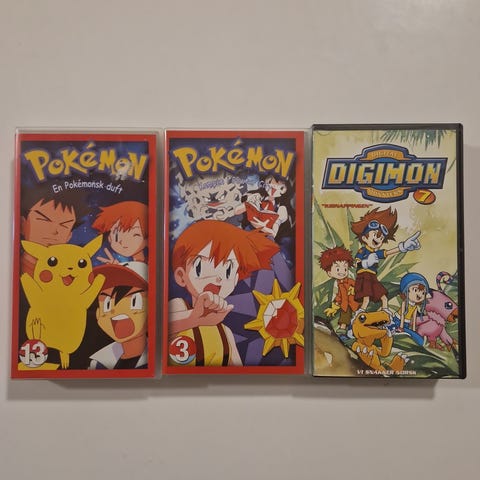
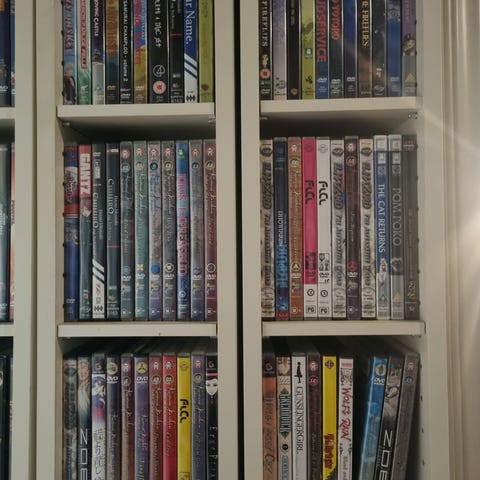
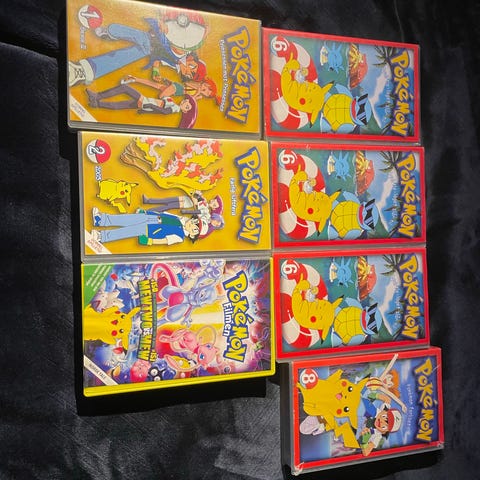
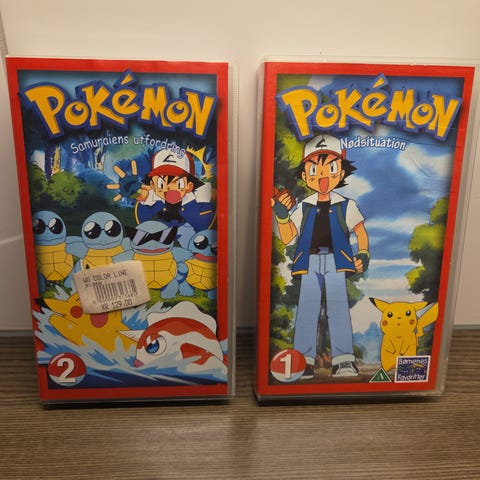
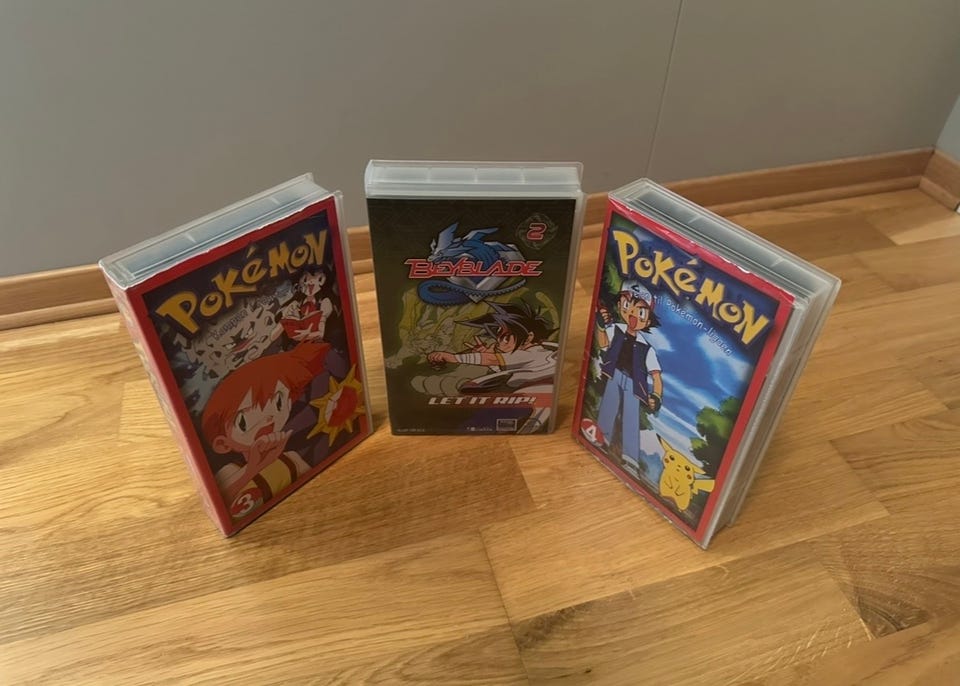
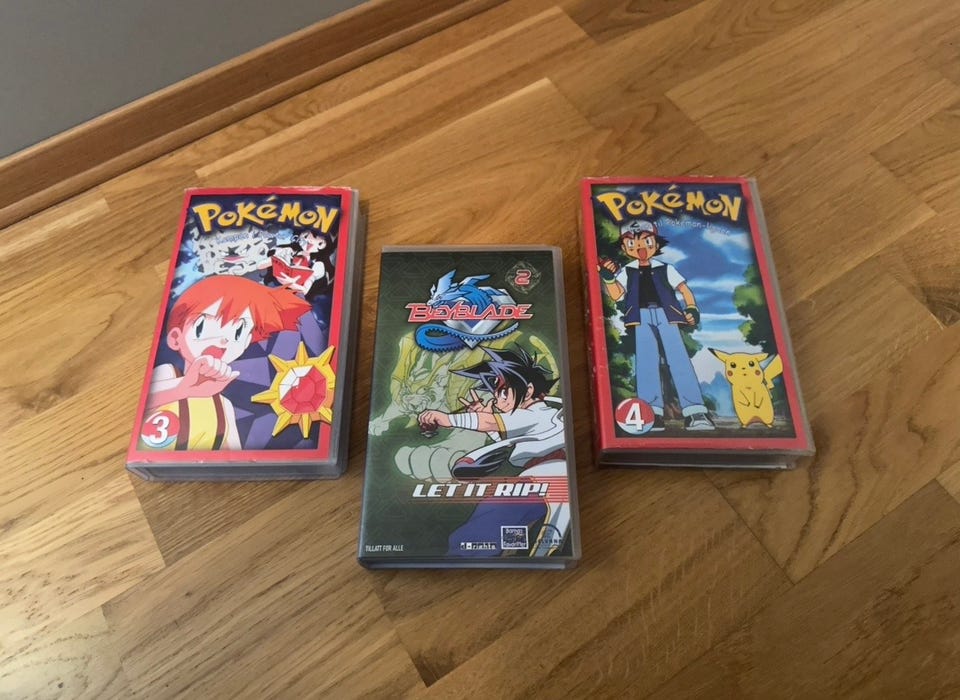
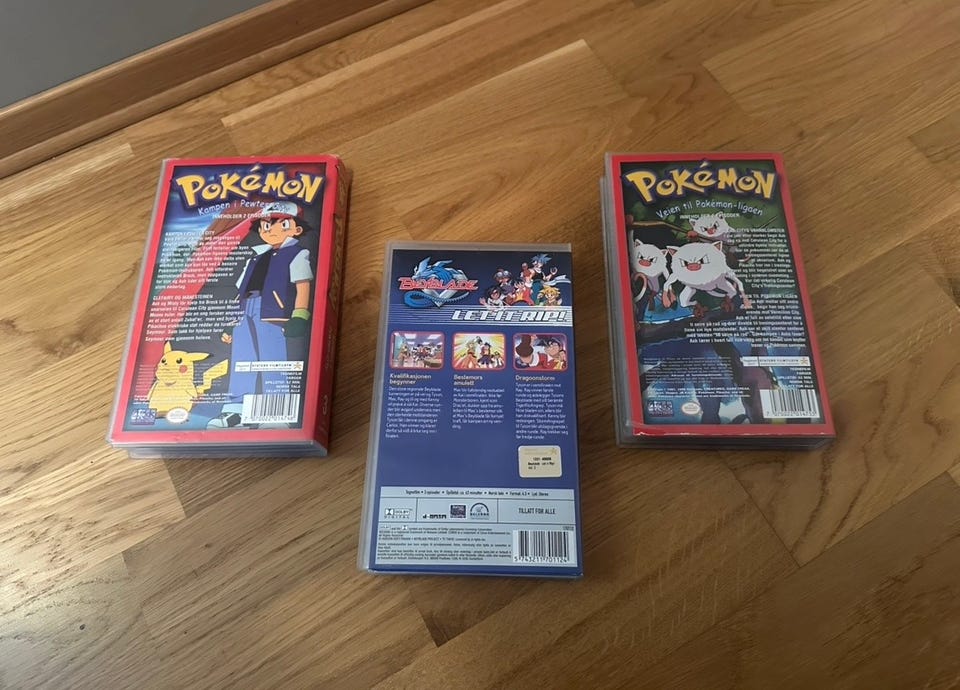
Selger 3 stykk vhs filmer samlet for kr 190,-
Filmene er :
Beyblade 2 let it rip
Pokemon 3 kampen i pewter city
Pokemon 4 veien til pokemon-ligaen
Kan hentes 7584 Selbustrand, ellers sendes frakt med sporing kr 70,-
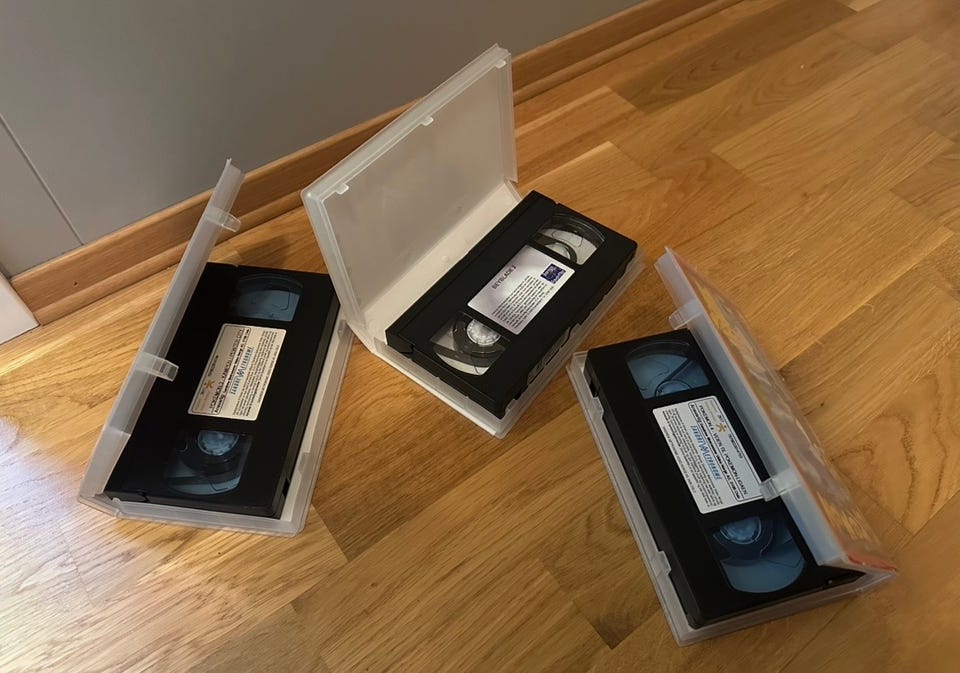
Har ikke testet filmene, kun sett av filmen ligger inni cover.
søkeord/wikipedia:Pokémon[a][b] is a Japanese media franchise consisting of video games, animated series and films, a trading card game, and other related media. The franchise takes place in a shared universe in which humans co-exist with creatures known as Pokémon, a large variety of species endowed with special powers. The franchise's primary target audience is children aged 5 to 12,[2] but it is known to attract people of all ages.[I] Pokémon is estimated to be the world's highest-grossing media franchise and is one of the best-selling video game franchises. The franchise originated as a pair of role-playing games developed by Game Freak, from an original concept by its founder, Satoshi Tajiri. Released on the Game Boy on 27 February 1996, the games became sleeper hits and were followed by manga series, a trading card game, and anime series and films. From 1998 to 2000, Pokémon was exported to the rest of the world, creating an unprecedented global phenomenon dubbed "Pokémania". By 2002, the craze had ended, after which Pokémon became a fixture in popular culture, with new products releasing to this day. In the summer of 2016, the franchise spawned a second craze with the release of Pokémon Go, an augmented reality game developed by Niantic. Pokémon is jointly owned by publisher Nintendo and developers Game Freak and Creatures.[1] Game Freak develops the core series RPGs, which are published by Nintendo exclusively for their consoles, while Creatures manages the trading card game and related merchandise, occasionally developing spin-off titles. The three companies established The Pokémon Company (TPC) in 1998 to manage the Pokémon property within Asia. The Pokémon anime series and films are co-owned by a production committee consisting of various companies, including Shogakukan which holds the rights to the manga series. Since 2009, The Pokémon Company International (TPCi), a subsidiary of TPC, has managed the franchise in all regions outside Asia.[12][13]
The original full name of the franchise is Pocket Monsters (ポケットモンスター, Poketto Monsutā), which has been commonly abbreviated to Pokemon (ポケモン) since its launch. When the franchise was released internationally, the short form of the title was used, with an acute accent (´) over the e to aid in pronunciation.[14] Pokémon refers to both the franchise itself and the creatures within its fictional universe. As a noun, it is identical in both the singular and plural, as is every individual species name.[15] Thus, it is grammatically correct to say "one Pokémon" and "many Pokémon", as well as "one Pikachu" and "many Pikachu" The player character takes the role of a Pokémon Trainer. The Trainer has three primary goals: travel and explore the Pokémon world; discover and catch a specimen of each Pokémon species in order to complete their Pokédex; and train a team of Pokémon and have them engage in battles.[21][22][23] Most Pokémon can be caught with spherical devices known as Poké Balls. Once the opposing Pokémon is sufficiently weakened, the Trainer throws the Poké Ball against the Pokémon, which is then transformed into a form of energy and transported into the device. If the catch is successful, the Pokémon is tamed and under the Trainer's command from then on. If the Poké Ball is thrown again, the Pokémon re-materializes into its original state.[24][25] The Trainer's Pokémon can engage in battles against opposing Pokémon, including those in the wild or owned by other Trainers.[26] Because the franchise is aimed at children, these battles are never presented as overtly violent and contain no blood or gore.[II] Pokémon never die in battle – they faint upon being defeated, and can then be rejuvenated at a Pokémon Center.[III]
The main idea behind Pokémon was conceived by Satoshi Tajiri. Tajiri was born on 28 August 1965,[35] and grew up in Machida, a suburb of Tokyo.[36] As a child, he enjoyed discovering and catching insects and other small creatures in the various ponds and fields that surrounded his town.[37][38] During Japan's economic miracle, many cities, including Machida, were significantly expanded. As a consequence, Machida's nature was largely destroyed. In his second year of junior high school,[39][40] an arcade hall opened in Tajiri's neighborhood, introducing him to video games. While studying electrical engineering at Tokyo College of Technology [ja], Tajiri began publishing a doujinshi magazine titled Game Freak. The title was inspired by the 1932 film Freaks, which Tajiri was fascinated with at the time.[41] He self-published the first issue of the magazine in March 1983, at the age of 17.[42][43] At the time, magazines specializing in video games did not yet exist in Japan, allowing Game Freak to fill a gap in the market.[44][45] Sometime later, Tajiri was contacted by aspiring manga artist Ken Sugimori, who became Game Freak's illustrator.[46] Game Freak folded in the late 1980s,[42] by which point Tajiri had become a respected game journalist in Japan's fledgling video game industry.[47] Through his work, Tajiri befriended Tsunekazu Ishihara, a Japanese business man who, among other things, produced game-related shows for Fuji Television.[48][49][50] In 1986, Tajiri, Sugimori, and a few other enthusiasts started an informal development team called Game Freak, named after the magazine it grew out of. Over the next few years, they independently developed the puzzle game Quinty, working on it alongside school or their regular jobs.[51] However, no one within the group knew how to make the game's music. After consulting all his contacts, Tajiri got in touch with Junichi Masuda, who became the group's composer.[52] Quinty was finished in 1989, and published by Namco.[53] Tajiri officially incorporated Game Freak Co., Ltd. on 26 April 1989.[54] Beyblade (Japanese: ベイブレード Beiburēdo) is a battling spinning top toyline and multimedia franchise developed by the Japanese toy company Takara. Inspired by the older beigoma, the first modern Beyblade was released in July, 1999 in Japan, along with a related manga series. It was called "Spin Dragoon" and also "Ultimate Dragoon." Following Takara's merger with Tomy in 2006, Beyblades are now developed by Takara Tomy. Various toy companies around the world have licensed Beyblade toys for their own regions, such as Hasbro in most Western countries and Sonokong in South Korea.
In Beyblade, participants compete in battles between two or more spinning tops called "Beyblades", or Beys.[1] A Beyblade typically consists of multiple parts, and players can combine parts to create their own combination.[2][3][4] Battles typically take place in a bowl-like stadium (called a Beystadium), into which players release Beyblades using a handheld launcher. A player wins if their Beyblade spins for a longer period of time or if the opponent's Beyblade exits the stadium. In Beyblade Burst and Beyblade X, players may also win if their opponent's Beyblade splits apart, known as "bursting". There are four successive series of Beyblade tops, each designed with its own component parts that are not compatible with tops of other series. Tops are designed for play only with tops of the same series, and each series has a separate media continuity. The first iteration, known simply as Beyblade and made mostly out of plastic, ran from 1999 to 2004. Beyblade: Metal Fusion (known as Metal Fight Beyblade in Japan), was introduced in 2008 featuring metal components.[clarification needed] Beyblade Burst introduced the "burst" mechanic and ran from 2015 to 2021. Beyblade X, the current iteration, began in 2023.
Every series of Beyblade has manga and anime series tie-ins. The original manga series was adapted into an anime series produced by Madhouse and Nippon Animedia (a partnership between Takara and Nippon Animation), and the related 2002 film Beyblade: Fierce Battle. The Beyblade: Metal Fusion anime adaptation, retroactively named Beyblade: Metal Saga, was produced by Tatsunoko Production and SynergySP for four seasons and accompanied by the 2010 action-adventure film, Metal Fight Beyblade vs the Sun: Sol Blaze, the Scorching Hot Invader. The spinoff anime BeyWheelz was released in 2012Both the toys and their names were inspired by the Beigoma, a traditional Japanese spinning top.[5] The concept is similar to Battling Tops, a spinning top game developed in 1968, and to the traditional spinning top games of topac,[6] gasing pangkah, and pambaram and the previous Japanese toy line of Spin Fighters (1993–1997). The toy line was introduced with an accompanying manga series of the same name in 1999. The manga ran from 1999 to 2004, while the anime only ran in 2001 with 51 total episodes. In 2002, Hasbro sold Beyblade toys internationally (under license from Takara) along with a coordinated country-by-country release of localized versions of the television show. On July 12, 2008, Takara Tomy released Metal Fight: Beyblade, the second generation of the toy. The third generation, titled Beyblade Burst, was released by Takara Tomy on July 18, 2015. The fourth generation of the toy line, Beyblade X, was released on June 2023.

Du må være logget inn for å se brukerprofiler og sende meldinger.
Logg innSist endret: 21.3.2026 kl. 17:12 ・ FINN-kode: 456526303