Fiks ferdig
30 kr
Tilstand: Som ny - Ikke synlig brukt
Innbundet som ny 120 sider sender gjerne kr 46 i frakt
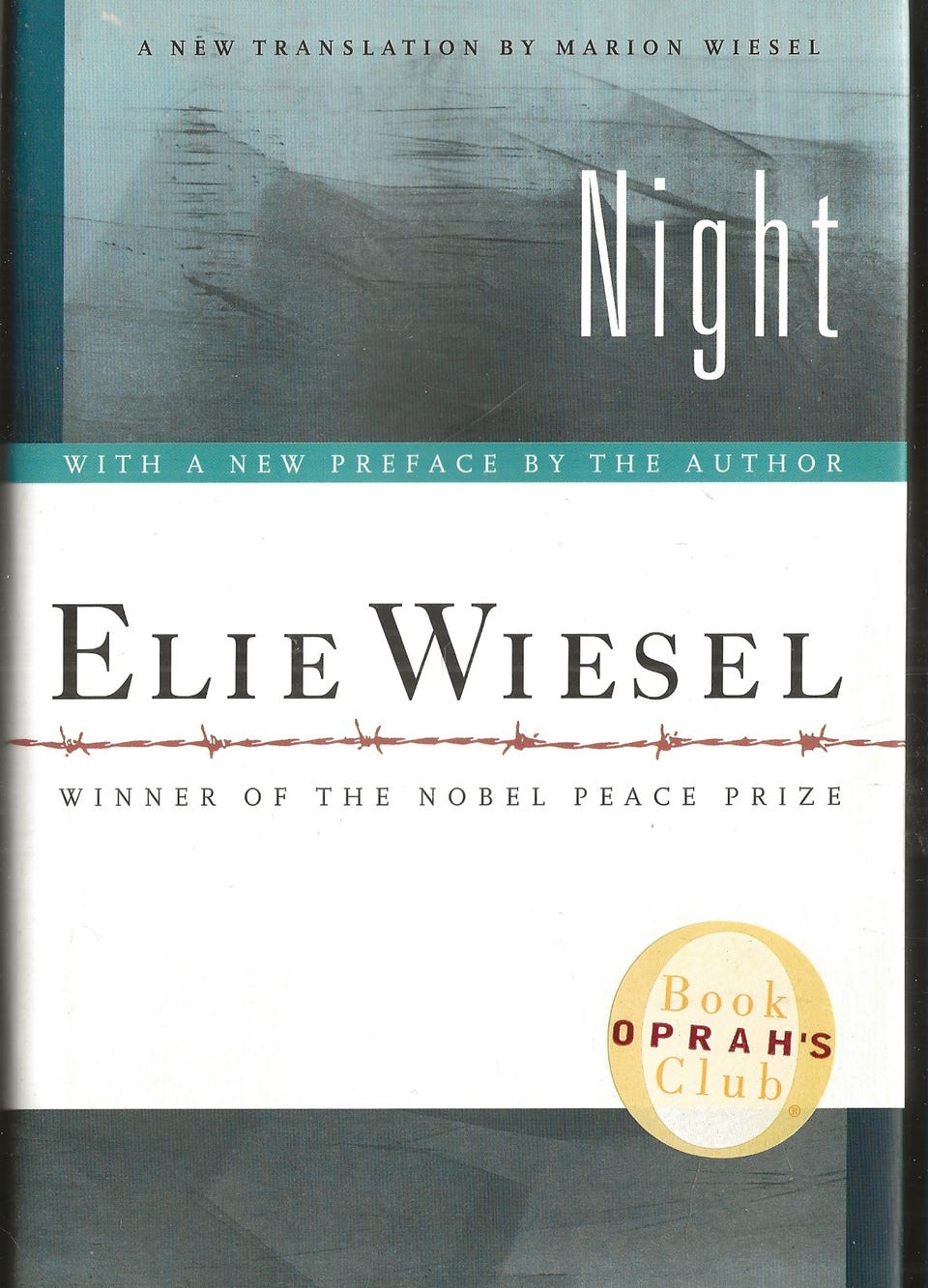
Night is a 1960 memoir by Elie Wiesel based on his Holocaust experiences with his father in the Nazi concentration camps at Auschwitz and Buchenwald in 1944–1945, toward the end of the Second World War in Europe. In just over 100 pages of sparse and fragmented narrative, Wiesel writes about his loss of faith and increasing disgust with humanity, recounting his experiences from the Nazi-established ghettos in his hometown of Sighet, Romania, to his migration through multiple concentration camps. The typical parent–child relationship is inverted as his father dwindled in the camps to a helpless state while Wiesel himself became his teenaged caregiver.[2] His father died in January 1945, taken to the crematory after deteriorating from dysentery and a beating while Wiesel lay silently on the bunk above him for fear of being beaten too. The memoir ends shortly after the United States Army liberated Buchenwald in April 1945.
After the war, Wiesel moved to Paris and in 1954 completed an 862-page manuscript in Yiddish about his experiences, published in Argentina as the 245-page Un di velt hot geshvign (Yiddish: און די װעלט האט געשװיגן, lit. 'And the World Remained Silent').[3] The novelist François Mauriac helped him find a French publisher. Les Éditions de Minuit published 178 pages as La Nuit in 1958, and in 1960 Hill & Wang in New York published a 116-page translation as Night.
Translated into 30 languages, the book ranks as one of the cornerstones of Holocaust literature.[4] It remains unclear how much of Night is memoir. Wiesel called it his deposition, but scholars have had difficulty approaching it as an unvarnished account. The literary critic Ruth Franklin writes that the pruning of the text from Yiddish to French transformed an angry historical account into a work of art.[5][6]
Night is the first in a trilogy—Night, Dawn, Day—marking Wiesel's transition during and after the Holocaust from darkness to light, according to the Jewish tradition of beginning a new day at nightfall. "In Night," he said, "I wanted to show the end, the finality of the event. Everything came to an end—man, history, literature, religion, God. There was nothing left. And yet we begin again with nigh

Du må være logget inn for å se brukerprofiler og sende meldinger.
Logg innSist endret: 14.2.2026 kl. 12:00 ・ FINN-kode: 451014862