Bildegalleri
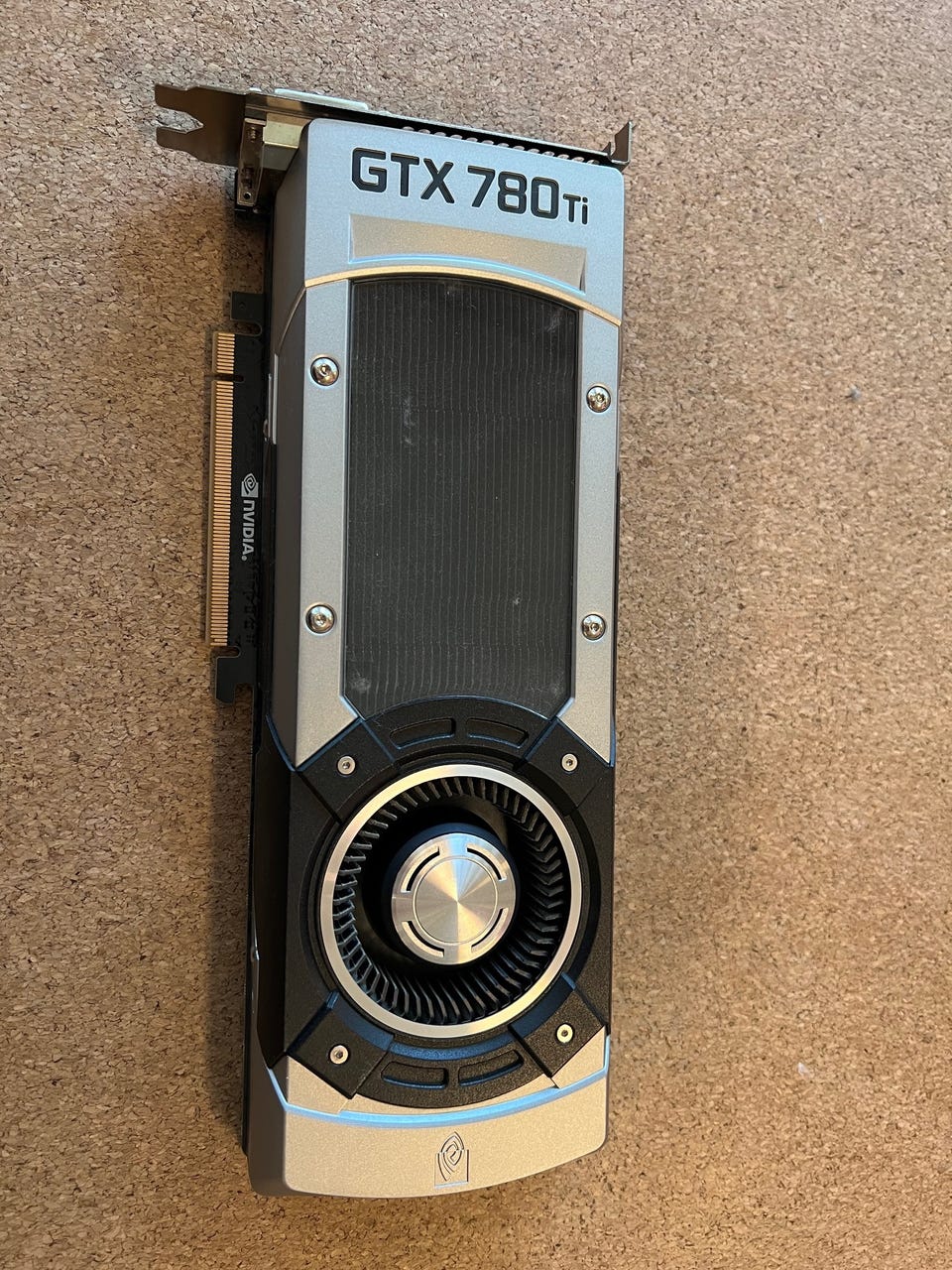
NVIDIA GeForce GTX 780 Ti 3GB Founders Edition
Til salgs
400 kr
Beskrivelse av varen
Tilstand: Pent brukt - I god stand
Type: Skjermkort
NVIDIA GeForce GTX 780Ti 3GB Founders Edition
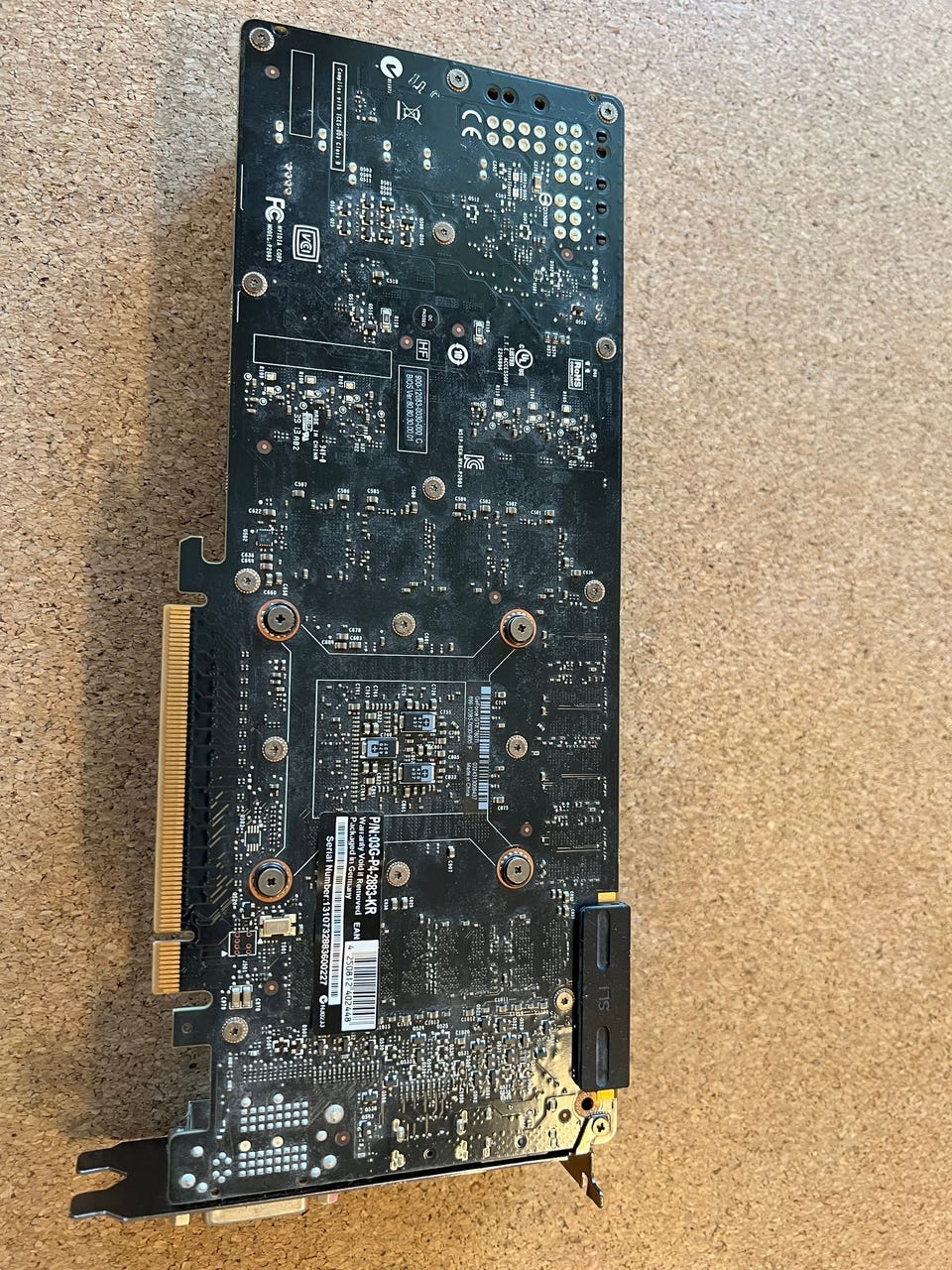
Testet og fungerer utmerket, kan kjøres i SLI.
Kan hentes eller sendes.
Kan sammenlignes med GTX 980 Ti og GTX 1080 Ti som også var toppmodeller i sin tid.
The GeForce GTX 780 Ti was an enthusiast-class graphics card by NVIDIA, launched on November 7th, 2013. Built on the 28 nm process, and based on the GK110B graphics processor, in its GK110-425-B1 variant, the card supports DirectX 12. Even though it supports DirectX 12, the feature level is only 11_1, which can be problematic with newer DirectX 12 titles. The GK110B graphics processor is a large chip with a die area of 561 mm² and 7,080 million transistors. It features 2880 shading units, 240 texture mapping units, and 48 ROPs. NVIDIA has paired 3,072 MB GDDR5 memory with the GeForce GTX 780 Ti, which are connected using a 384-bit memory interface. The GPU is operating at a frequency of 875 MHz, which can be boosted up to 928 MHz, memory is running at 1753 MHz (7 Gbps effective).
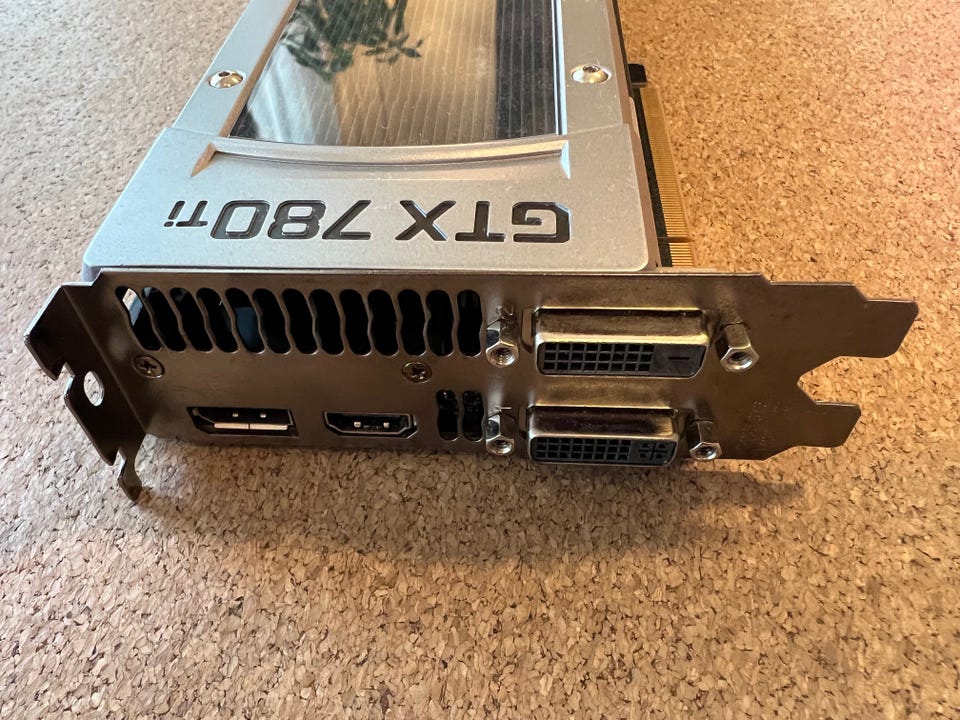
Being a dual-slot card, the NVIDIA GeForce GTX 780 Ti draws power from 1x 6-pin + 1x 8-pin power connector, with power draw rated at 250 W maximum. Display outputs include: 2x DVI, 1x HDMI 1.4a, 1x DisplayPort 1.2. GeForce GTX 780 Ti is connected to the rest of the system using a PCI-Express 3.0 x16 interface. The card's dimensions are 267 mm x 111 mm x 38 mm, and it features a dual-slot cooling solution. Its price at launch was 699 US Dollars.
Final Words
Bringing this review to a close, after having seen NVIDIA upstage themselves a couple of times this year already with GK110, it’s admittedly getting a bit harder each time to write about NVIDIA’s flagship GPU. NVIDIA won’t break significant new ground just by refreshing GK110, but gradual performance increases in conjunction with periodic price drops have kept the market fresh while making NVIDIA’s high-end cards a bit faster and a bit cheaper each time. So in that respect we’re enthusiastic about seeing NVIDIA finally release a fully enabled GK110 GeForce card and the performance improvements it brings.
With that in mind, with the release of the GeForce GTX 780 Ti NVIDIA is once more left solidly in control of the single-GPU performance crown. It won’t quite get to claim a massive performance advantage over its closest competitors, but at the end of the day it’s going to be faster than any other single-GPU card out there. This will break down to being 11% faster than Radeon R9 290X, 9% faster than GTX Titan, and a full 20% faster than the original GTX 780 that it formally replaces.
To that end, while NVIDIA can still charge top dollar for their flagship card it’s a sign of the times and of the competition that they released their fully enabled GK110 part as a cheaper GTX 780 series card. At $700 it’s by no means cheap – and this has and always will be the drawback to NVIDIA’s flagships so long as NVIDIA can hold the lead – but it also means that NVIDIA does need to take AMD’s Radeon R9 290 series into account. As such the 290X and the GTX 780, though lesser performing parts, will remain as spoilers for GTX 780 Ti due to their better balance of performance and pricing. All the while GTX 780 Ti stands at the top of the heap for those who want the best.
Meanwhile we bid au revoir to the original GK110 GeForce card, GTX Titan. Though GTX Titan will still be on the market as an entry level compute card, it is finally dethroned as the fastest single-GPU gaming card in NVIDIA’s lineup. At least for the time being GTX Titan is still very secure in its place in the market as a compute card, and so there it will continue, a position that reflects the fact that there’s little need for NVIDIA to keep their gaming and compute products commingled together as a single product. Though we wouldn’t be the least bit surprised if NVIDIA made additional prosumer products of this nature in the future, as GTX Titan clearly worked out well for the company.
And though GTX Titan is falling off of our radar, we’re glad to see that NVIDIA has kept around Titan’s second most endearing design element, the Titan cooler. We won’t hazard to guess just how much it costs NVIDIA over a cheaper design (or what it adds to the final price tag), but with GTX 780 Ti NVIDIA has once again proven just how capable the cooler is when paired with GK110. Even with the slightly higher power consumption of GTX 780 Ti versus the cards that have come before it, thanks to that cooler GTX 780 Ti still hits an excellent sweet spot between performance and noise, offering the flexibility and simplicity of a blower without the noise that has traditionally accompanied such a cooler. And all the while still delivering more than enough performance to hold on to the performance crown.
Finally, let’s talk about SLI for a moment. Much like GTX Titan before it, GTX 780 Ti is so fast that it’s almost more than enough on its own for any standard single-monitor resolution. Even 2560x1440 with high settings isn’t enough to bog down GTX 780 Ti in most games, which makes a pair of GTX 780 Tis in SLI overkill by any definition. Properly using that much power requires multiple monitors, be it an Eyefinity/Surround setup, or more recently a tiled 4K monitor.
In either scenario a GTX 780 Ti is going to be a solid performer for those segments, but NVIDIA is going to have to deal with the fact that their performance advantage is going to melt away with the resolution increase. Right now a single GTX 780 Ti has a solid lead over a single 290X, but a pair of GTX 780 Tis is going to tie with a pair of cheaper 290Xs at 4K resolutions. And with 290X’s frame pacing under control NVIDIA no longer has that advantage to help build their case. GTX 780 Ti still has other advantages – power and noise in particular – but it does mean we’re in an interesting situation where NVIDIA can claim the single-GPU performance crown while the crown for the dual-GPU victor remains up for grabs. It's still very early in the game for 4K and NVIDIA isn't under any great pressure, but it will be an area of improvement for the next generation when Maxwell arrives in 2014.
Brukerprofil

Du må være logget inn for å se brukerprofiler og sende meldinger.
Logg innAnnonsens metadata
Sist endret: 5.6.2025 kl. 08:27 ・ FINN-kode: 406362164
Utforsk våre nye sider for klær og mote
Ta en titt