Bildegalleri
(1/5)


D.W. FEARN & HAZELRIGG INDUSTRIES D Series 500 Series Modules
Til salgs
Beskrivelse
Svært begrenset antall Hazelrigg D series 500 Moduler på lager hos oss for umiddelbar levering!
Ta kontakt for tilbud!
Forbehold om utsolgt!
Introducing The Hazelrigg Industries D Series
New from Hazelrigg Industries, the D Series of 500 Series modules deliver the tone, clarity and musical control that you’ve come to expect, presented in a portable, cost-effective package. Modules include the DVA Vacuum Tube Microphone Preamplifier/DI, DLC Vacuum Tube Inductor Equalizer, and DNE Pulse Width Modulation Compressor.
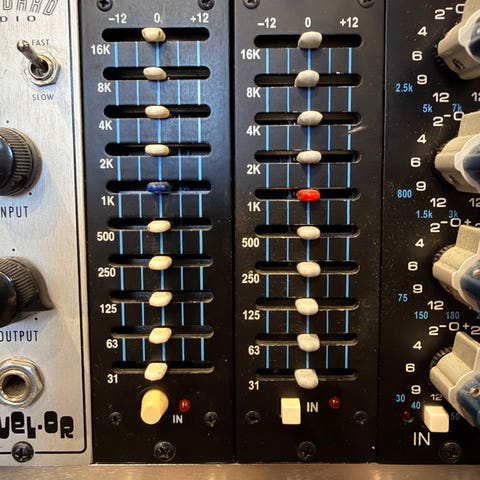
DLC Vacuum Tube Inductor Equalizer
The DLC is based on the passive equalizer circuit in the Hazelrigg Industries VLC (originally found in the D.W. Fearn VT-5). It shares the same filter capacitors and handwound inductor as the VLC, though the audio path is slightly different. The input audio circuit comes from the D.W. Fearn VT-2, while the output uses a low THD/high gain solid state amplifier design. Like the VLC, the DLC uses transformers in both input and output stages.
User tips: Boosting and cutting simultaneously can create complex equalization curves. Try turning up all knobs except the bass boost, switch frequencies to the desired settings, then bring the bass boost up until the sound is balanced.
DNE Pulse Width Modulation Compressor
The DNE gets its compression circuitry directly from the Hazelrigg Industries VNE and D.W. Fearn VT-7. Attack and release times have been optimized to simplify the user interface. The High Pass Filter (HPF) makes the compressor less reactive to low frequencies (for example, bass and kick).
Linking units require 500 series racks with a link option. Signal path utilizes input and output transformers and low-THD/high-gain solid state devices. Gain reduction is shown with LEDs.
User tips: The PWM methodology is capable of extremely fast attack and release times. When compressing bass-oriented instruments, it is possible to have audio artifacts when the release is set too fast. This is usually not an issue on program material.
When linking units, attack and release times will be averaged. Units do not have to be set exactly the same. However, keep in mind that if the threshold is not turned up on a DNE, the side chain won’t reference the audio passing through the unit, even though it may be compressing it if linked.
DVA Vacuum Tube Microphone Preamplifier/DI
The DVA is a hybrid microphone preamplifier based on the Hazelrigg Industries VLC and D.W. Fearn VT-2 preamp. Utilizing a single 6072a vacuum tube, the input circuitry matches the VLC/VT-2 input stage exactly and features transformers in both the input and output stages.
Make-up gain is provided by a low-THD/high output solid state signal path (as opposed to the vacuum tube circuits in the VLC/VT-2) due to the module size and power supply limitations inherent in the 500 series format. Total gain available is approximately 60db.
User tips: Many condensers have a high output and require an input pad to avoid overloading the input transformer. If needed, we suggest using the pad on the microphone if available.
Users looking for ‘saturation’ can try engaging the -20 db pad and sending the DVA an attenuated signal, then adjust gain for tone and output.
Ta kontakt for tilbud!
Forbehold om utsolgt!
Introducing The Hazelrigg Industries D Series
New from Hazelrigg Industries, the D Series of 500 Series modules deliver the tone, clarity and musical control that you’ve come to expect, presented in a portable, cost-effective package. Modules include the DVA Vacuum Tube Microphone Preamplifier/DI, DLC Vacuum Tube Inductor Equalizer, and DNE Pulse Width Modulation Compressor.
DLC Vacuum Tube Inductor Equalizer
The DLC is based on the passive equalizer circuit in the Hazelrigg Industries VLC (originally found in the D.W. Fearn VT-5). It shares the same filter capacitors and handwound inductor as the VLC, though the audio path is slightly different. The input audio circuit comes from the D.W. Fearn VT-2, while the output uses a low THD/high gain solid state amplifier design. Like the VLC, the DLC uses transformers in both input and output stages.
User tips: Boosting and cutting simultaneously can create complex equalization curves. Try turning up all knobs except the bass boost, switch frequencies to the desired settings, then bring the bass boost up until the sound is balanced.
DNE Pulse Width Modulation Compressor
The DNE gets its compression circuitry directly from the Hazelrigg Industries VNE and D.W. Fearn VT-7. Attack and release times have been optimized to simplify the user interface. The High Pass Filter (HPF) makes the compressor less reactive to low frequencies (for example, bass and kick).
Linking units require 500 series racks with a link option. Signal path utilizes input and output transformers and low-THD/high-gain solid state devices. Gain reduction is shown with LEDs.
User tips: The PWM methodology is capable of extremely fast attack and release times. When compressing bass-oriented instruments, it is possible to have audio artifacts when the release is set too fast. This is usually not an issue on program material.
When linking units, attack and release times will be averaged. Units do not have to be set exactly the same. However, keep in mind that if the threshold is not turned up on a DNE, the side chain won’t reference the audio passing through the unit, even though it may be compressing it if linked.
DVA Vacuum Tube Microphone Preamplifier/DI
The DVA is a hybrid microphone preamplifier based on the Hazelrigg Industries VLC and D.W. Fearn VT-2 preamp. Utilizing a single 6072a vacuum tube, the input circuitry matches the VLC/VT-2 input stage exactly and features transformers in both the input and output stages.
Make-up gain is provided by a low-THD/high output solid state signal path (as opposed to the vacuum tube circuits in the VLC/VT-2) due to the module size and power supply limitations inherent in the 500 series format. Total gain available is approximately 60db.
User tips: Many condensers have a high output and require an input pad to avoid overloading the input transformer. If needed, we suggest using the pad on the microphone if available.
Users looking for ‘saturation’ can try engaging the -20 db pad and sending the DVA an attenuated signal, then adjust gain for tone and output.
NB: Knappen for å vise hele beskrivelsen har kun en visuell effekt.
Nøkkelinfo
- Tilstand
- Ny
Beliggenhet
| FINN-kode | 403156554 |
|---|---|
| Sist endret | 3.9.2025 kl. 23:53 |