Bildegalleri
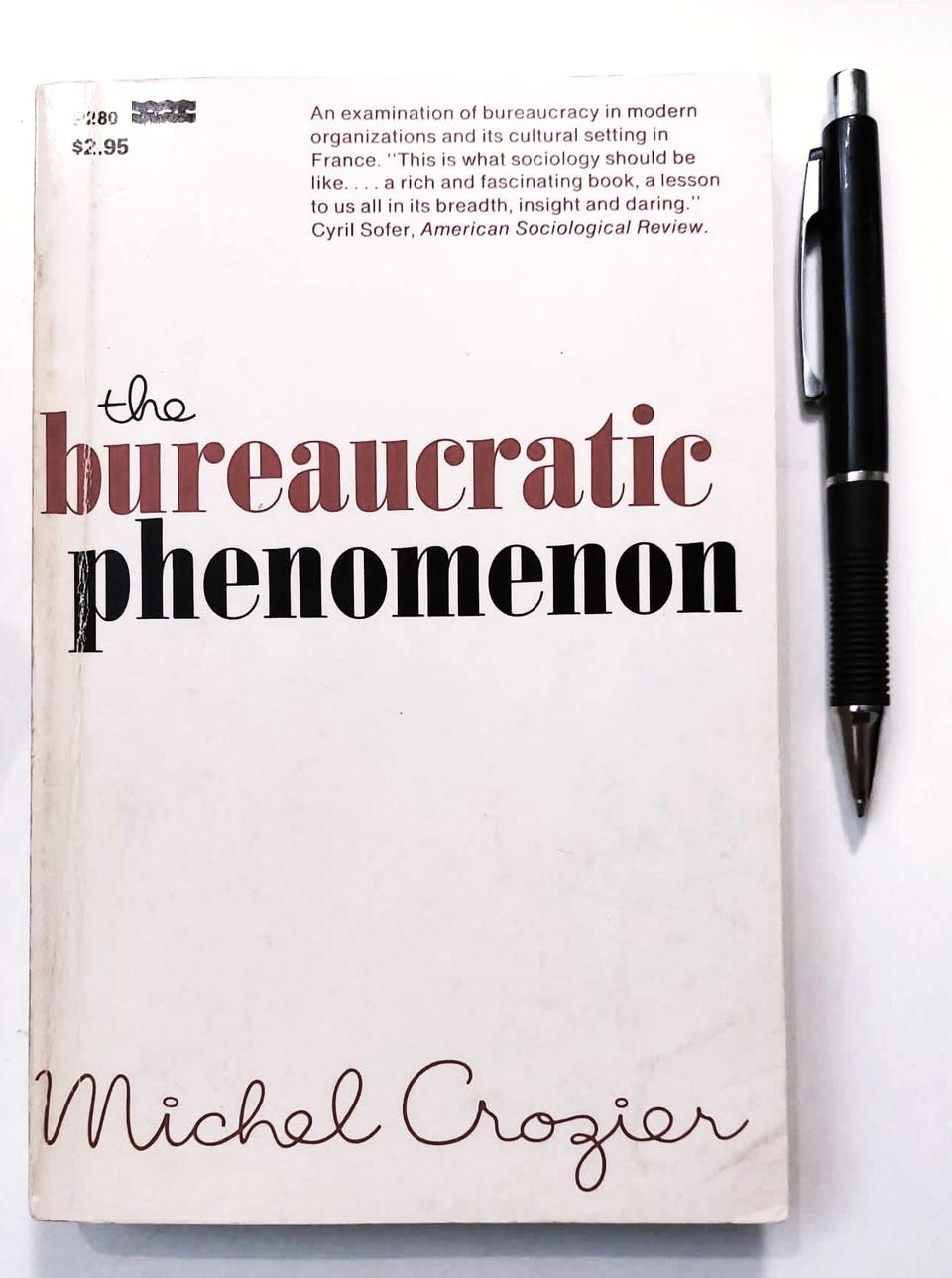
The Bureaucratic Phenomenon - Michel Crozier. (Klassiker fra 1964)
Til salgs
Frakt fra 38 kr + Trygg betaling 39 kr
Trygg handel med Fiks ferdig
Etter levering har du 24 timer til å se over varen. Hvis det er noe galt med varen, får du pengene dine tilbake.
Lag en pakke
Kjøp mer fra selgeren og betal bare én fraktkostnad.
Beskrivelse av varen
NB! Litt markeringer med kulepenn her og der, - ellers i god stand.
Kan hentes i Bergen sentrum, sendes med Fiksferdig, eller sendes med Posten/Postnord uten Finn-gebyr.
Se gjerne mine andre annonser for samsending av flere bøker for samme porto.
Michel Crozier's The Bureaucratic Phenomenon (1964) is a classic work in organizational sociology, arguing that bureaucracies aren't just rigid systems but are shaped by cultural context, power struggles, and the need to manage uncertainty, leading to "vicious circles" of dysfunction, especially in French public service. Crozier combined decision-making theory with cultural analysis, revealing how informal power dynamics and cultural traits (like French centralization) create unique bureaucratic patterns, contrasting with purely rational models like Weber's.
Key Concepts & Contributions
Cultural Context Matters: Bureaucratic behavior isn't solely due to rules but is deeply embedded in a society's cultural patterns.
Power & Uncertainty: Bureaucracies form to protect against risks, but power struggles over uncertain zones (where rules are weak) create informal systems and dysfunctions.
"Vicious Circles": Inefficient patterns emerge as groups use formal rules to gain power, leading to more rigid rules, further creating uncertainty, and repeating the cycle.
French Model: Crozier identified a specific French model based on centralization, isolated strata, and individual initiative, differing from potential American or Japanese models.
Beyond Weber: While acknowledging Max Weber, Crozier showed that real-world bureaucracies are messy, political, and varied, not just ideal-type rational machines.
Significance
It bridged organizational theory with cultural sociology, offering a nuanced view of how people navigate large organizations.
It became foundational for understanding public administration, policy processes, and the political nature of bureaucracies, influencing the "bureaucratic politics" approach.
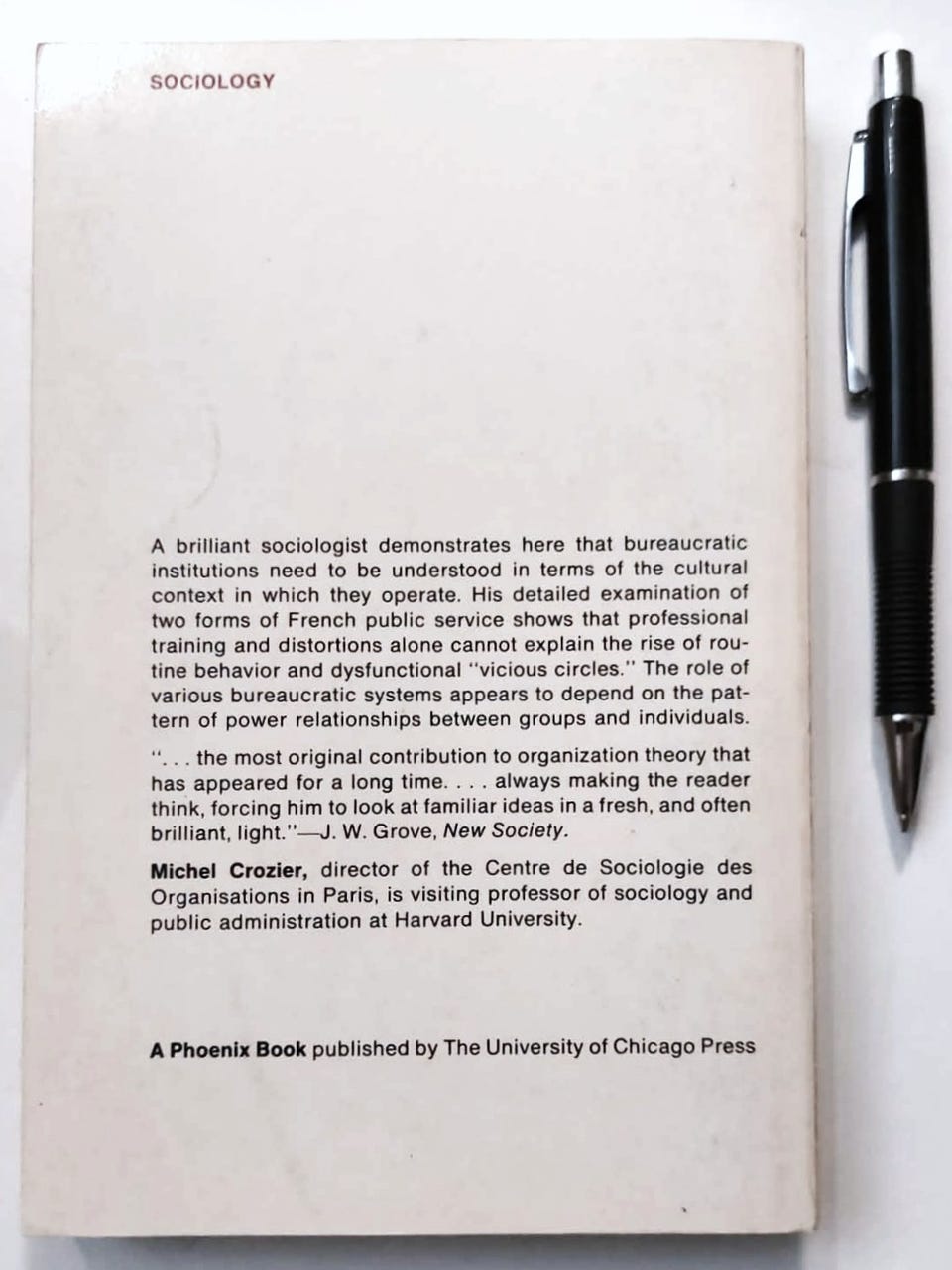
In The Bureaucratic Phenomenon Michel Crozier demonstrates that bureaucratic institutions need to be understood in terms of the cultural context in which they operate. The originality of the study lies in its association of two widely different approaches: the theory of decision-making in large organizations and the cultural analysis of social patterns of action.
The book opens with a detailed examination of two forms of French public service. These studies show that professional training and distortions alone cannot ex plain the rise of routine behavior and dysfunctional "vicious circles." The role of various bureaucratic systems appears to depend on the pattern of power relation ships between groups and individuals. Crozier's findings lead him to the view that bureaucratic structures form a necessary protection against the risks inherent in collective action.
Since systems of protection are built around basic cultural traits, the author presents a French bureaucratic model based on centralization, strata isolation, and individual sparkle-one that that can be contrasted with an American, Russian, or Japanese model. He points out how the same patterns can be found in several areas of French life: education, industrial relations, politics, business, and the colonial policy. Bureaucracy, Crozier concludes, is not a modern disease resulting from organizational progress but rather a bulwark against development. The breakdown of the traditional bureaucratic system in modern France offers hope for new and fruitful forms of action.
Table of Contents
Introduction PART ONE THE CASE OF THE CLERICAL AGENCY I. The Over-all Organization and the Employees' Individual Adjustments to Their Tasks 2. Interpersonal and Intergroup Relationships and the Problem of Routine PART TWO THE INDUSTRIAL MONOPOLY 3· The Social System at the Shop Level: The Plant Subculture and the Formal Authority System 4· The Social System at the Shop Level: The Relationships between Groups and the Adjustment Patterns of Groups 5· Power Relationships at the Management Level I PART THREE BUREAUCRACY AS AN ORGANIZATIONAL SYSTEM 6. Power and Uncertainty 7· The Bureaucratic System of Organization PART FOUR BUREAUCRACY AS A CULTURAL PHENOMENON: THE FRENCH CASE 8. The French Bureaucratic System of Organization 9· The Importance of Bureaucratic Patterns of Action in the French Social System 10. The Bourgeois Entrepreneur and Bureaucracy 11. The Bureaucratic Phenomenon and the French Model as Part of the Over-all Development of Industrial Society
sosiologi
Brukerprofil

Du må være logget inn for å se brukerprofiler og sende meldinger.
Annonsens metadata
Sist endret: 22.2.2026 kl. 13:00 ・ FINN-kode: 443018924